FALCON FLASH
Dateline: Cleveland, Ohio
March 26, 2007
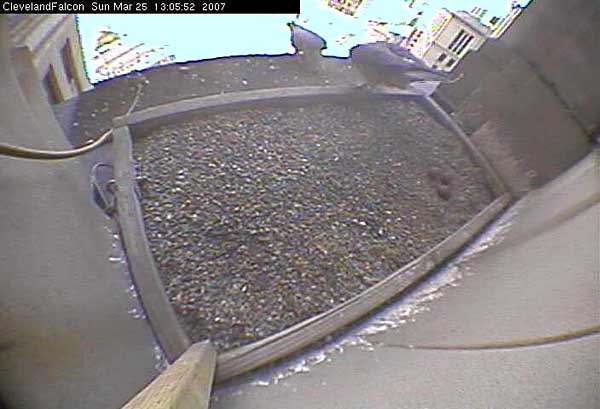
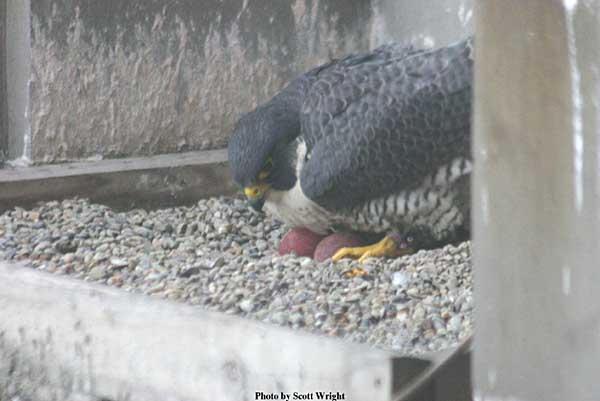
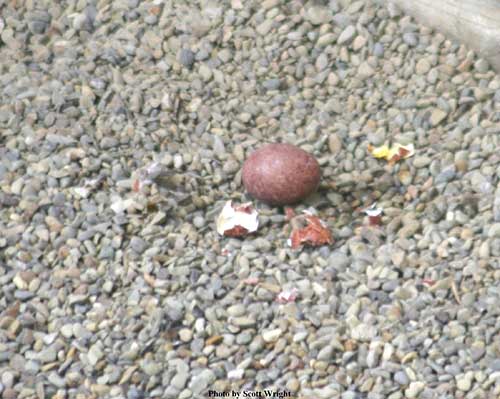
SW and Buckeye are the proud parents of 3 eggs (and one broken egg)…..
Scott Wright, nest monitor, was asked about the broken egg and reports that new research has just been released. Peregrine falcon eggs from Maine and New Hampshire have been analyzed and found to contain the highest levels of the toxic chemical “deca-BDE” ever recorded. The falcon eggs contained nearly ten times higher deca levels than peregrine eggs from Sweden, where all such chemicals have been banned. Matt Prindiville, Toxics Project Director for the Natural Resources Council of Maine, stated, “The Peregrine falcon was threatened in the mid ’70s with extinction, due to reproductive failure resulting from egg-shell thinning caused by DDT. Now it looks like the threat of DDT has been replaced with a new class of toxic compounds, PBDEs, which may be accumulating in the peregrines’ food chain and causing the birds harm.”
Did SW’s egg break because of a thin shell caused by a chemical?
For the next month or so, SW will spend most of her time incubating the eggs. Buckeye will sit on the eggs for a few hours each day so that SW can go out and stretch her wings. Most importantly, Buckeye will catch food and bring it to SW. When it is cold the parents will sit very tight, because the precious eggs must not be uncovered for even a minute or two.
According to the Canadian Peregrine Foundation, incubation usually lasts 33 to 35 days from the date the last egg, or the second last, was laid. You can do the math and figure out approximately when the first chick will hatch. There is a lot of information available at the Canadian Peregrine Foundation at: http://peregrine-foundation.ca/
When asked about retrieving a piece of SW’s broken eggshell for analysis, Mr. Wright replied,
“At this time in the nesting cycle, no windows can be opened. The birds would attack. In such attacks the egg(s) in the nest would be in danger of possible damage as the adults would violently attack the arm reaching into the nest. Trust me - one year a baby falcon less than 5 days old died in the nest. I and a member of the Ohio Division of Wildlife went out the window to get the dead baby falcon chick. The female, Zenith, walked up my left arm and was a few inches from my face beaking my arm as she walked up it. She was able to take a hunk out of my arm through my shirt and not make a hole in my shirt! And Szell, the male, was swooping past as I shook Zenith off my arm and she fell into the nest hard. It would be great to have a piece of the broken eggshell to analyze, but the risk to the egg(s) and the danger to a human is not worth the risk. If SW and Buckeye had stopped sitting on the egg or refused to go into the box, then a decision would have been made by ODW to get the shell and remove the egg. But Mr B, in his remarkable usual wisdom, moved the egg and now they are taking turns sitting on the eggs in a different scrape.”
For more information about chemicals found in falcon eggs, visit:
Will there be more eggs? Keep your eyes and browser set to:
Our thanks to the Cleveland Museum of Natural History for sponsoring the FalconCams and for the still of the nestbox.
Photos are courtesy of Scott Wright. They can be used in any non-commercial publication, electronic or print, but please give photo credit.