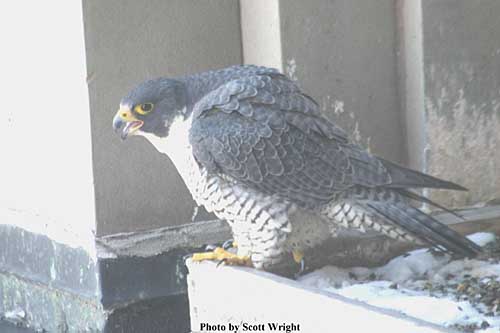
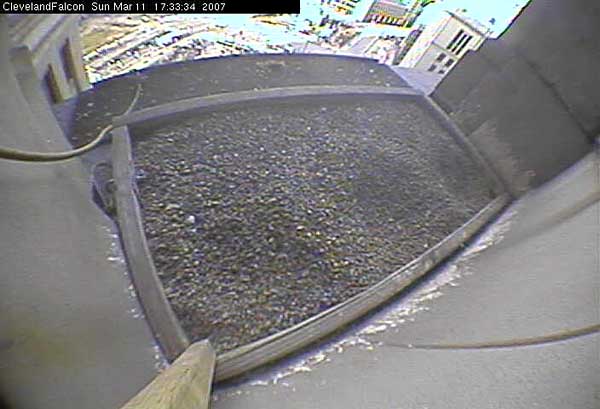
SW is "egg-specting". Nest monitor, Scott Wright, was at the nest recently and reports that SW is heavy with eggs. He adds that at this stage "the female is in a "lethargic egg-laying" phase where she will not stray very far form the nest. She will not fly much and in general, like any expectant female of any species, her activities will be naturally limited by the additional weight she is now carrying.
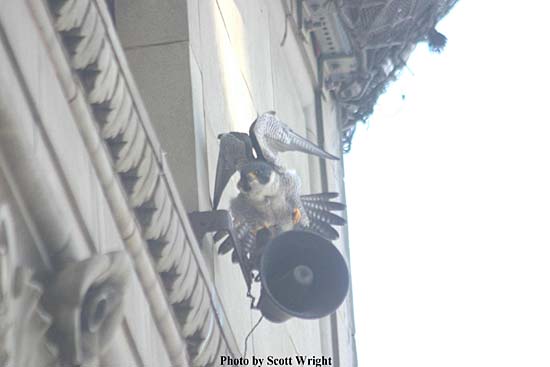
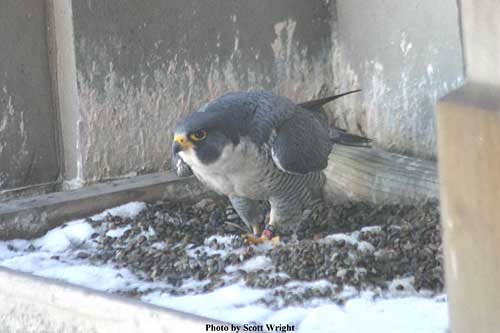
As humans began to build skyscrapers in the 20th century, peregrines adapted to the cliff-like buildings and found cities to their liking. At first, peregrines would lay their eggs on a skyscraper ledge and the eggs would often roll off the building during bad weather. Humans have helped nesting peregrines in cities by building nestboxes to avoid this problem. I you have been watching the FalconCam, you may have noticed Buckeye and SW scrape an indentation in their nestbox gravel just as they would on a rocky cliff in the wild. In the following picture you can see Buckeye putting the final touches on one of the scrapes that he made in the gravel of the nestbox on the 12th floor ledge of their skyscraper home.
Buckeye is always close by and is feeding her, as the female will not hunt during this phase.
The eggs (when they are laid) are laid every other day, four eggs will take 7 days to lay. That means she will be in labor every other day and may experience 4 bouts of labor in under one week."
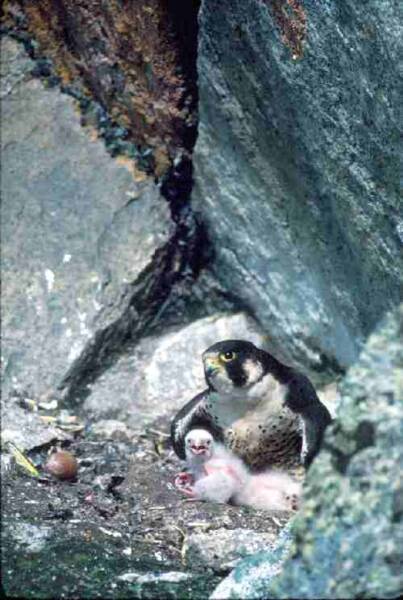
Throughout most of their natural history, peregrine falcons have nested on high, remote cliff ledges that are difficult to reach. The nestsite or "eyrie" (also spelled "aerie") really is not a nest but a shallow depression, or "scrape," in the rocks and soil. The following photo from the U.S. Fish and Wildlife Service shows what a peregrine nestsite looks like on a rocky cliff.
When will the first egg arrive? Last year, the first egg was laid sometime after dark on March 10 -11th and the year before the first egg was laid sometime after dark on March 15 -16. How many eggs will there be?