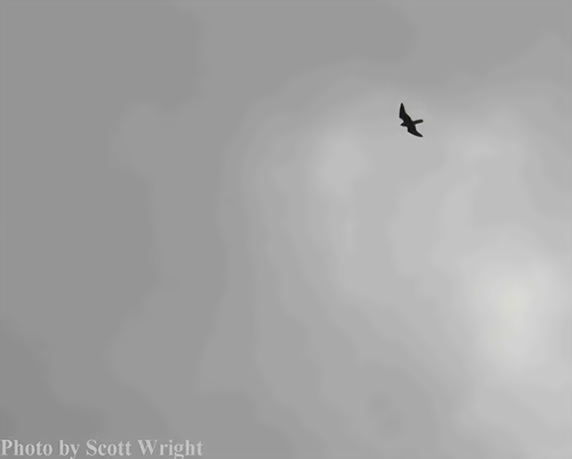
Where have all the falcons gone? If you have been monitoring the FalconCams, you haven’t seen much of them lately. They are out practicing their flying and hunting skills, with SW and Buckeye teaching and watching over them.
Nest monitors, Mr. and Mrs. Saladin, describe juvenile fledgling behavior: “The juvies chase adults in the air, seeking food and practicing their aerial skills. They knock the adults off of perches trying to urge them to hunt for them. The juvies play in the air in what is referred to as "mock combat", chasing one another, stooping, maneuvering, tagging each other with their feet, and even inverting as if practicing for food exchanges.
They grab at leaves, and snap twigs off of dead trees. They often snatch butterflies, dragonflies, and insects as their initial prey items and eat "on the wing". The juvies become progressively more aggressive toward the adults, and the adults, in turn perch in less conspicuous places and often try to hide from the juvies. The juvies chase adults even after they have recently eaten and mantle their prey from adults and siblings to keep it from being taken. As juvies get more advanced the parent will drop prey for them to catch and will even bring in live, wounded prey, so that the juvies can practice chasing and catching. The juvies also try to steal food from one another in the air, and chase after the juvie that gets the prey while calling loudly. They also go on "family hunting forays" where the adults and juvies cooperative hunt”.
Soon, the chicks will begin their own lives and fly to parts unknown. Since they wear bands, we may find out what happens to them. Where will they go and how will their lives turn out?
This draws the 2009 Raptors in the City program to a close. Will Buckeye and SW return to their Terminal Tower nestsite in Cleveland in 2010? Be sure to join us early next year when the cycle of life begins again.
Our thanks to the Cleveland Museum of Natural History for sponsoring the FalconCams. Learn more about the museum at:
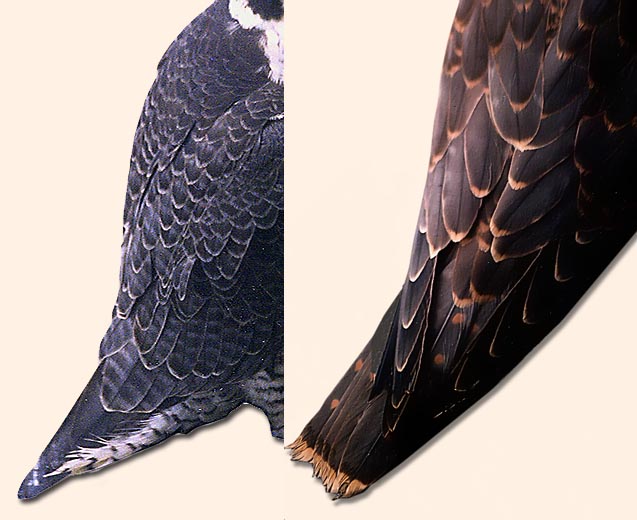
Our special thanks to Scott Wright, volunteer peregrine nest monitor for the Ohio Division of Wildlife, for his many years of care and concern for the survival of the species and for the nest. And thanks to Mr. Wright for the generous use of his fabulous photos, including today’s feather closeups.
Thanks also to Mr. and Mrs. Saladin for their descriptions and file photos of juvenile behaviors.
Pictures may be used by children for school and/or personal projects, but please photo credit.
In addition, our thanks to all people who have contributed to saving the species peregrine falcon in North America. With the help of people from all walks of life, the species is returning to health after nearly becoming extinct in North America.
Nest monitor, Mr. Wright, explains that “The first few months of flying are dangerous for young peregrines as they must learn to fly successfully at high speeds. Think of a teenager who just gotten his or her driver's license and then is handed the keys to a car that can go 150MPH!!! One thing Mother Nature does to help the new flyers survive is to give them "Speed Brakes" of a sort. If you look closely at the edges of the juvenile feathers you can see a brownish ROUGH edge. This causes a slower flow of air over the wing and makes the young falcons fly slower than adults who have molted into adult feathers”. Look closely at pictures of the young falcons and compare them to their parents to see the difference in plumage. SW's adult plumage is on the left - notice the difference in color as well as the structure. Juvenile feathers are on the right and show "Nature's Speed Brakes".