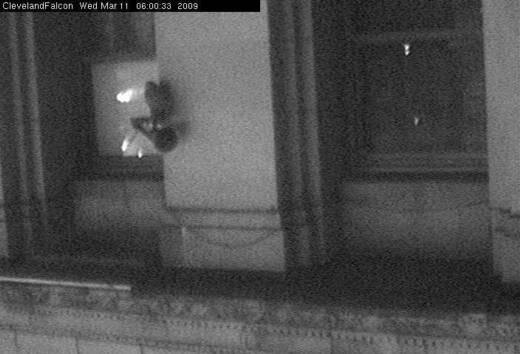
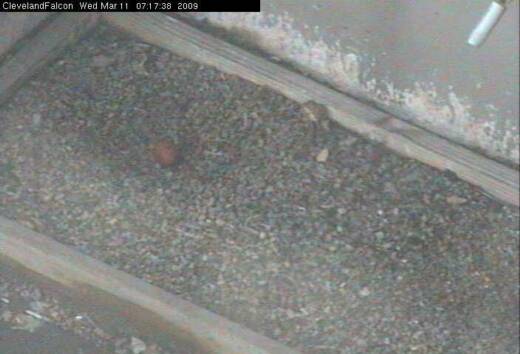
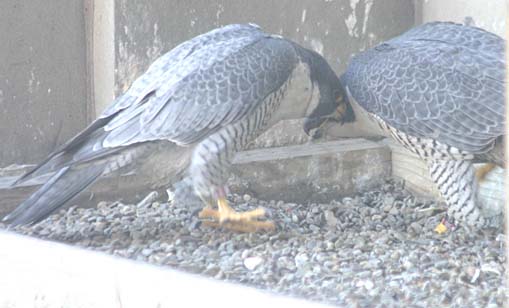
This morning as the sun came up, falcon fans strained their eyes to see SW in the scrape and Buckeye watching over her. The falcons kept their fans guessing whether there was an egg beneath SW.......
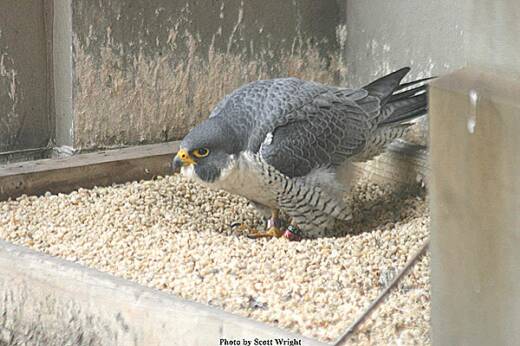
As humans began to build skyscrapers in the 20th century, peregrines adapted to the cliff-like buildings and found cities to their liking. At first, peregrines would lay their eggs on a skyscraper ledge and the eggs would often roll off the building during bad weather. Humans have helped nesting peregrines in cities by building nestboxes to avoid this problem. If you have been watching the FalconCam, you may have noticed Buckeye and SW scrape an indentation in their nestbox gravel just as they would on a rocky cliff in the wild. In the following picture you can see Buckeye putting the final touches on a scrape that he made in the gravel of the nestbox on the 12th floor ledge of their skyscraper home.
Scott Wright, volunteer nest monitor for the Ohio Division of Wildlife reports: "Eggs will be laid every other day until SW is done, with up to 2 days between eggs. In my many years of nest monitoring, I have noticed every other day the average."
Active incubation (male and female taking turns sitting on the eggs) often does not begin until the 2nd or 3rd egg, because the eggs are inert until they are incubated.
Our thanks to the Cleveland Museum of Natural History for sponsoring the FalconCams and for the stills.
Photos are courtesy of Scott Wright, volunteer peregrine nest monitor. They may be used by children for school and/or personal projects, but please give Mr. Wright photo credit. All others must contact Mr. Wright directly for permission to use his photos.
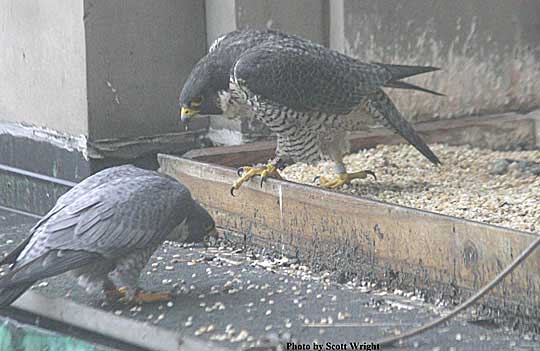
Over the past weeks, SW and Buckeye have been courting, and Buckeye would often display an interesting falcon behavior during courtship as he “bowed” to SW. In the picture below, you can tell it’s Buckeye who is bowing, because he is smaller than SW. Male peregrines are about one-third smaller than females and are called “tiercels”, which comes from an old French word meaning “one-third”. Female peregrines are larger than the males, and they can be aggressive toward their mates. Sometimes the female will even take food from the male and chase him. Some scientists believe the male approaches his mate cautiously and bows to her to as if to say “please don’t hurt me”, but since the male is a fierce predator also, he may be bowing to show his mate he is not a threat to her.
And there was! We think the first egg was laid sometime after dark March 10th or early morning on March 11 th.
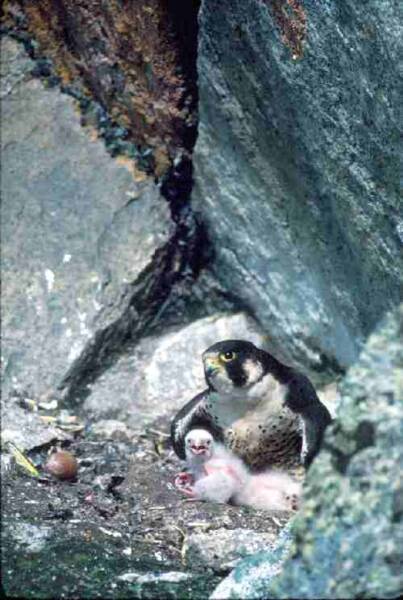
SW and Buckeye, like many other peregrine couples, nest on a skyscraper. However, throughout most of their natural history, peregrine falcons have nested on high, remote cliff ledges that are difficult to reach. The nestsite or "eyrie" (also spelled "aerie") really is not a nest but a shallow depression, or "scrape," in the rocks and soil. The following photo from the U.S. Fish and Wildlife Service shows what a peregrine nestsite looks like on a rocky cliff.
In the following picture you can see a tender courtship moment as the falcons touched beaks.