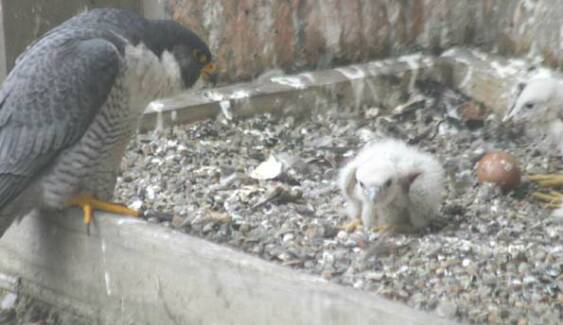
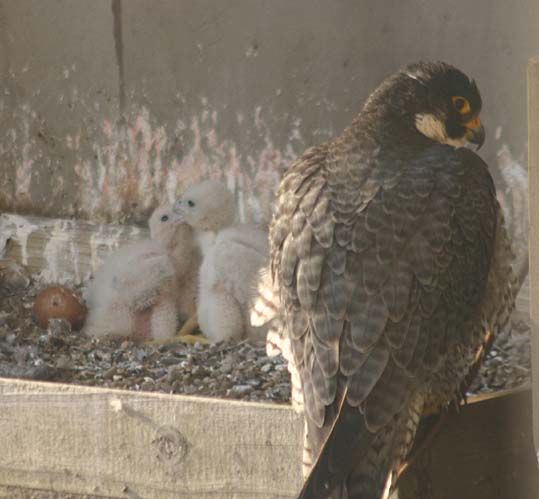
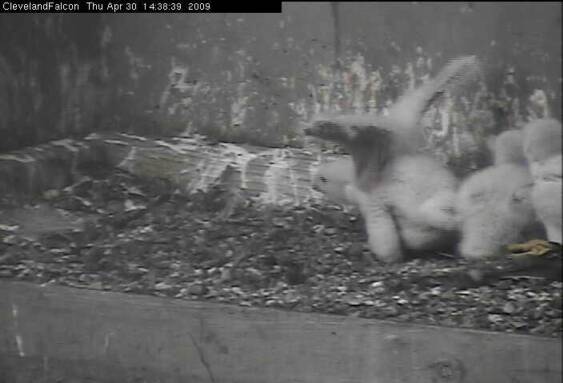
Mr. Scott Wright, peregrine falcon nest monitor at this site for 17 years, visited the nestsite, and he is guessing we have 2 females and one male this year. He reports that the smallest eyas, possibly a male, hobbled over to Buckeye looking for food. If you have been monitoring the FalconCam, you may have noticed that the eyases are beginning to move around the nest. At first, they "walk" on their tarsi (heel bones). Later on, they will begin to walk on their toes, as adult birds do.
Mr. Harvey Webster, director of wildlife resources with the Cleveland Museum of Natural History, tells us, “As you peruse the photo archives you will see that S/W is spending less time covering the young. Before you call her parenting methods into question, here are some observations.
First, the chicks have grown so large that they barely fit beneath her. Second, the daytime temperatures are moderating and it is not as cold. But most importantly, the chicks are getting to the point where they no longer need her body heat to sustain their own. With the rapid growth of the chicks’ bodies and the emergence of feathers replacing their natal down, the chicks reach a sort of critical mass where they can maintain their own body temperature without the help of the parents. At that point the chicks are said to be thermo-competent. The parents will still shield them from the elements as needed but they will no longer brood them. You might also notice that the chicks will no longer huddle as often and will move apart from one another to be cooler.
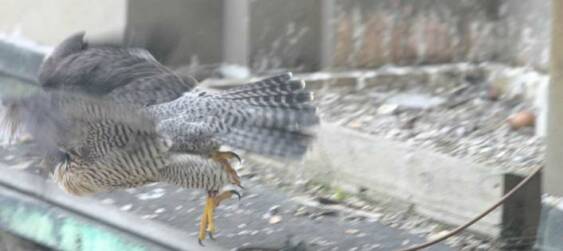
Soon the appetites of the chicks will be such that both adults will have to hunt full-time during the daylight hours to provide enough food for the growing family”.
After the peregrine falcon becomes a mature adult, it is at the top of the food chain and does not fear other predators, but while the chicks are helpless, the peregrine parents must watch over their young to protect them from predators -especially the great horned owl.
Mr. Wright tells us, "Only three of the eggs have hatched …. In years past we have had eggs that did not hatch. The first year at this nestsite, the female (Zenith) laid 3 eggs and one did not hatch. In fact, it exploded all over Zenith. That year the eggs were not laid until early June and did not hatch until July 4/5. It was a very warm month and you can picture what would happen if you kept an egg at over 100 degrees for just over a month!!!! One year 7 eggs did not hatch”.
Our thanks to the Cleveland Museum of Natural History for sponsoring the FalconCams.
File photos are courtesy of Scott Wright, volunteer peregrine nest monitor. They may be used by children for school and/or personal projects, but please give Mr. Wright photo credit. All others must contact Mr. Wright directly for permission to use his photos.
For city falcons, this is not a problem, since great horned owls are not common in cities. It is possible that many peregrine couples have decided to nest in cities across North America because there are few, if any, predators on skyscrapers. In fact, as humans were helping the species to recover from the brink of extinction, some nestboxes were placed on skyscrapers with the hope of avoiding chick predation by the great horned owl. Scott Wright, volunteer peregrine falcon nest monitor was told by the Ohio Division of Wildlife one year that peregrines forced down a great horned owl who dared to fly near their nestsite. When the owl was found on a roof near the nest, it was missing an eye! The great horned owl is a very large bird of prey (much larger than the crow-sized peregrines) with a wingspan of nearly 5 feet. For more information about the great horned owl visit: http://www.mbr-pwrc.usgs.gov/id/framlst/i3750id.html
However, there is a trade-off for lack of predators in cities. When the eyases become fledglings and take their first flights, city buildings and electrical wires are dangerous obstacles for young birds who don’t know how to fly very well.
As you monitor the FalconCam for development, it’s a good idea to keep a Falcon Journal, because the chicks grow and change every day. Already, in less than 2 weeks, they are beginning to walk and flap.