FALCON FLASH
Dateline: Cleveland, Ohio
May 22, 2009
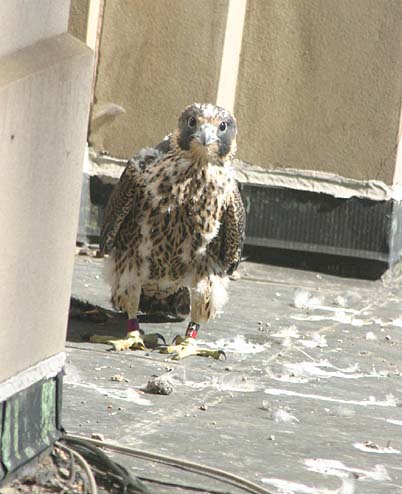
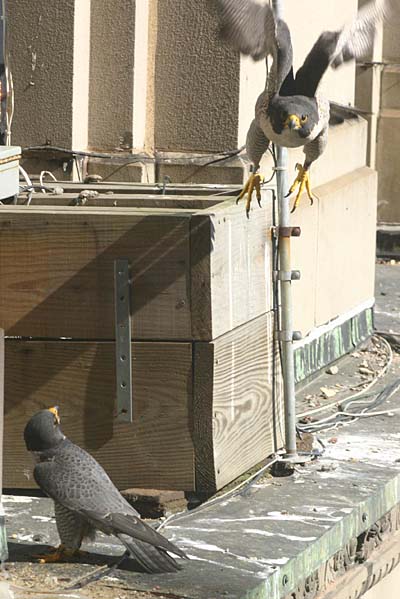
Where have all the falcons gone? Out walking on the building’s ledges. If you’ve been watching the FalconCam lately, you know that they aren’t at the nest much anymore. Here is Strike on a walk…..
Soon the juvenile falcons will be taking their first flight. This is called “fledging”. Sara Jean Peters, of the Ohio Division of Wildlife (retired) tells us:
“Like children learning to walk, flight is a series of experiments...some successful, some not.
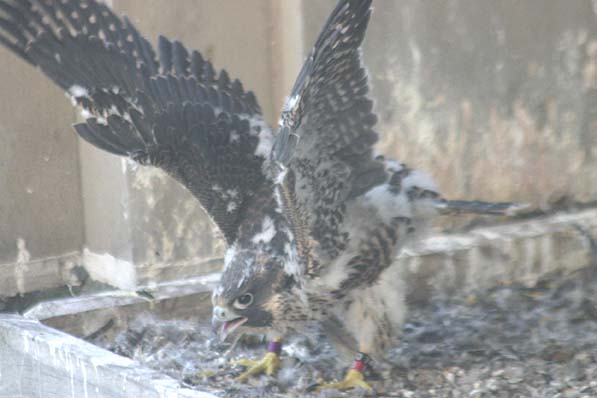
Chicks typically exercise their wings, flapping in place, hopping and flapping, and running and flapping. If their nest is on a cliff, updrafts can actually catch under the extended wings and lift the birds up into the air and to a higher ledge. There are updrafts in the city as well, although the ledges aren't as numerous.
A chick that flushes from the ledge and takes flight too early may end up on the ground...a risky place in the city as well as at the foot of a cliff. It takes more muscle power to fly UP than out. Muscle development comes with age and exercise. The first flight made by an older chick will probably be more successful than that made by a younger chick. Landings, a very important part of flights, take lots of practice regardless of age!”
This is Lunge flap, flap, flapping.
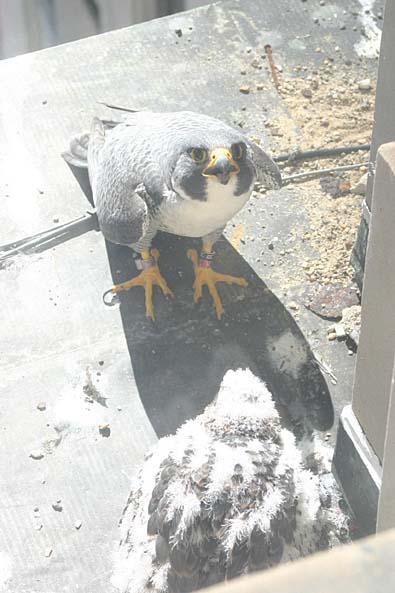
Mr. Wright reports, “Strike is a ledge racer and just runs all over, she has no fear of me at windows looking at her. She sized me up at one point then walked away”.
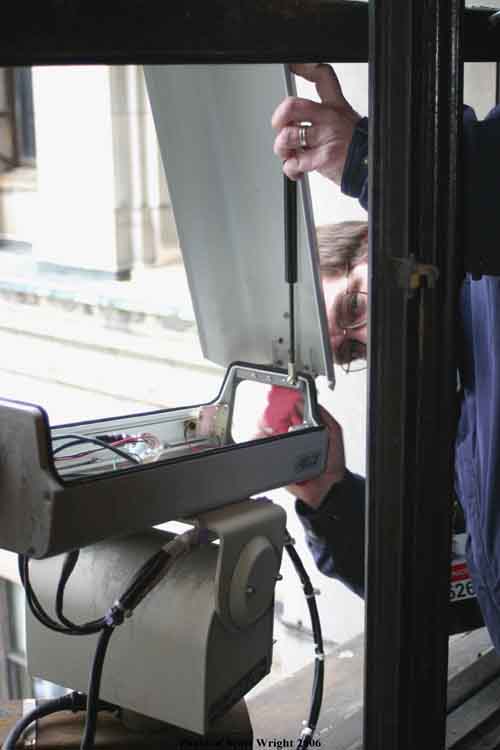
When nest monitor, Mr. Wright, visits the nest and takes pictures, he is inside the skyscraper on the 12th floor watching the falcons through the windows. Here he is leaning out the window to clean the lens of the FalconCam.
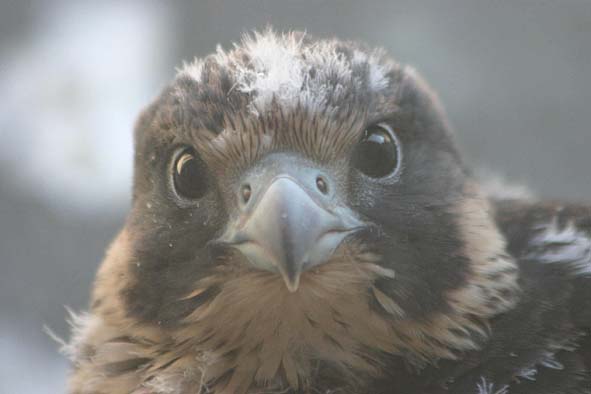
Mr. Wright reports that when he visited recently and took these pictures, SW and Buckeye were not happy to see him behind the windows, so he didn’t stay very long. Here is Buckeye protecting Cirrus from Mr. Wright.
Stay tuned for fledging news……….
Photos are courtesy of Scott Wright, volunteer peregrine nest monitor. They may be used by children for school and/or personal projects, but please give Mr. Wright photo credit. All others must contact Mr. Wright directly for permission to use his photos.