


FALCON FLASH
Dateline: Cleveland, Ohio
April 6, 2011
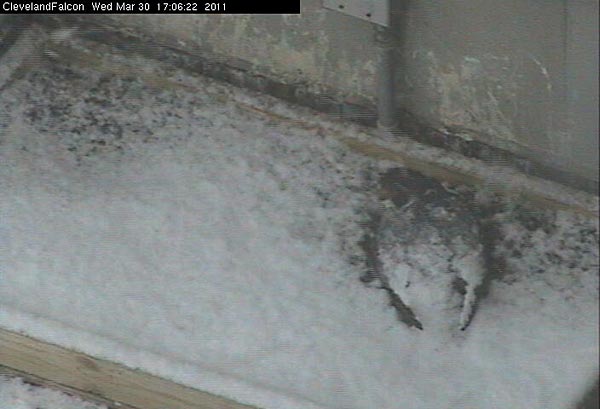
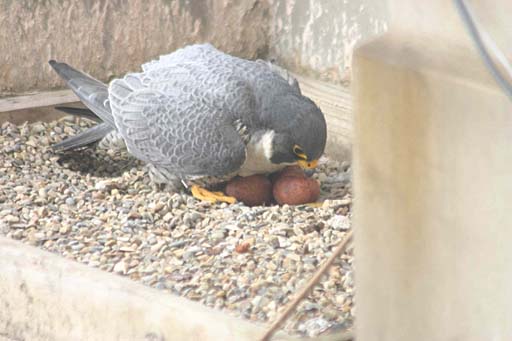
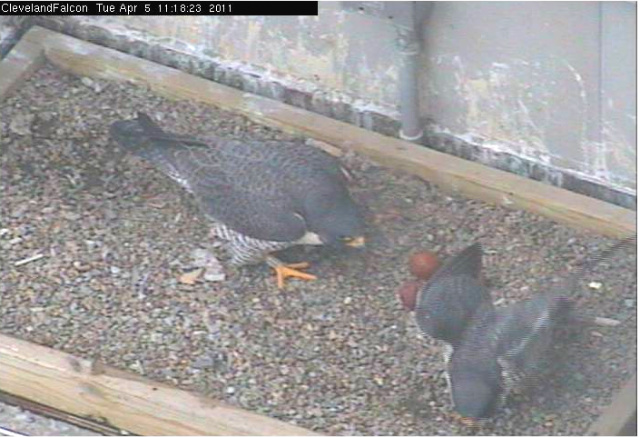
Incubation seems to be progressing smoothly. SW and Boomer are very good parents and take turns egg-sitting. Boomer is proving himself to be a very good father during his first time being a dad. Here he is keeping the eggs warm and dry in snow.

Click here to read what happened earlier
If you have been studying the FalconCam, you may have noticed that SW or Boomer turn and rearrange their eggs about once every hour. (Click on the FalconCam Archives, located under each picture on the front page at http://www.falconcam-cmnh.org/news.php in order to see pictures of all the day's activities).
The World Center for Birds of Prey in Boise, Idaho explains this interesting bird behavior: "Birds rotate their eggs to keep the eggs evenly warm or cooled (depending on weather). If the clutch is large, then the eggs on the outside are moved into the center of the clutch where the temperature maybe a few degrees higher. Eggs are also rotated to prevent the developing embryo from prematurely sticking to the inner membrane of the egg. If the egg stays in one position for too long, then the embryo can stick to the inner membrane. This may cause the embryo to develop or hatch improperly”.
The World Center for Birds of Prey suggests, “You could dissect a chicken egg to reveal the basic components of the egg. Most ornithology books will explain the anatomy of the egg. A store bought egg will do. The eggs are not fertilized, so may not show all components of the egg. Break the shell open gently and pour onto a smooth surface. You will also want to look at the eggshell, so don't destroy it. If you have a dissecting microscope you could see the pores on the outside of the eggshell. This is where gas exchange occurs. Oxygen goes in and carbon dioxide goes out. Have fun." In the following video you can see last year’s male at this nestsite perform this very important task:
For a diagram of a chicken egg, which shows the basic parts of a bird’s egg, go to: http://sites.ext.vt.edu/virtualfarm/poultry/poultry_eggparts.html
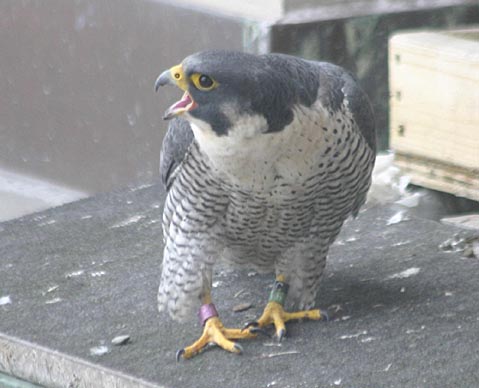
If you have been watching SW and Buckeye as they incubate their eggs, you may have wondered about their lives. Because the peregrine falcon was on the List of Endangered Species for 30 years, many birds are banded and their life histories are known. SW was hatched and fledged from the 37th floor of the Gulf Tower building in Pittsburgh, PA in 1999. Pennsylvania does not believe in naming wild creatures, so she goes by her band letters, SW.
See if you can find these cities on a map. Can you figure out how far Boomer had to fly to meet SW in Cleveland, Ohio?
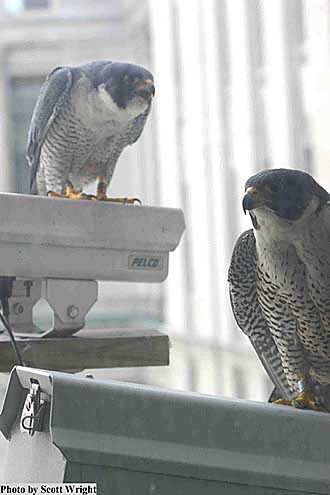
Can you tell who’s who in a peregrine falcon couple? You probably already know that the best clue is the size difference. A tiercel (male) is about one-third smaller than a female.
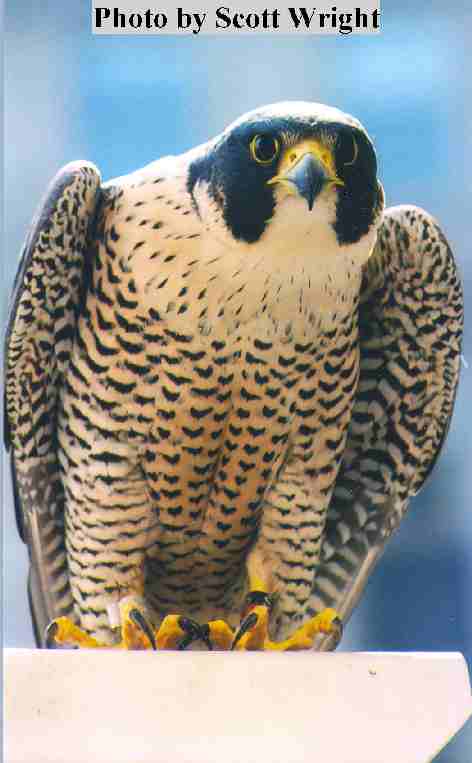
Boomer was hatched in Columbus, Ohio in 2008.
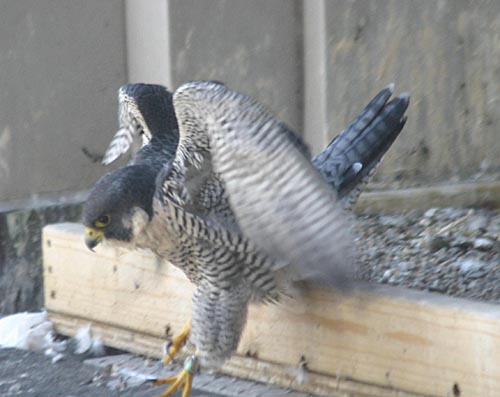
The precious eggs are almost always covered to keep them warm and dry. SW does most of the egg-sitting but Boomer relieves her from time to time. Here is a “shift change” at the nest and a peek at the eggs………..
Boomer departs after his turn…..
The Peregrine Fund, located at the World Center for Birds of Prey, led the way to save the species peregrine falcon. Falcon lovers owe our gratitude to this organization, as well as many others, for the survival of the peregrine in North America. Today they continue working to save birds of prey species around the world. Visit them at: http://peregrinefund.org/
To watch the falcons live go to: http://www.falconcam-cmnh.org/news.php
Our thanks to the Cleveland Museum of Natural History for sponsoring the FalconCams and for the stills.
Photos are courtesy of Scott Wright, volunteer peregrine nest monitor. Video is courtesy of Mr. and Mrs. Saladin, volunteer peregrine nest monitors. They may be used in any non-commercial publication, electronic or print, but please give photo and video credit.
Click here to read what happened next
