


FALCON FLASH
Dateline: Cleveland, Ohio
May 31, 2011
Where have all the falcons gone? Out walking on the building’s ledges! (That’s Dad on the lower ledge watching 2 juveniles above).

Click here to read what happened earlier
You may have noticed that ever since the eggs were hatching, when you could see eggshells everywhere, the nestbox is a mess.
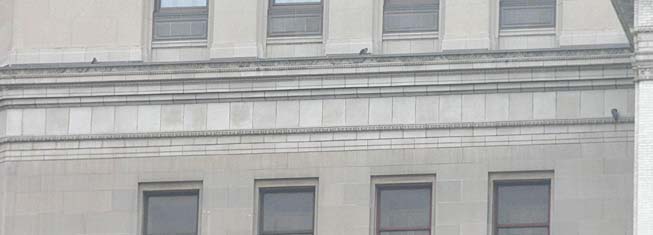
If you’ve been watching the FalconCams lately, you know that the nest is empty much of the time. Here is someone out for a walk…..

And where has all the down gone? Going, going……………
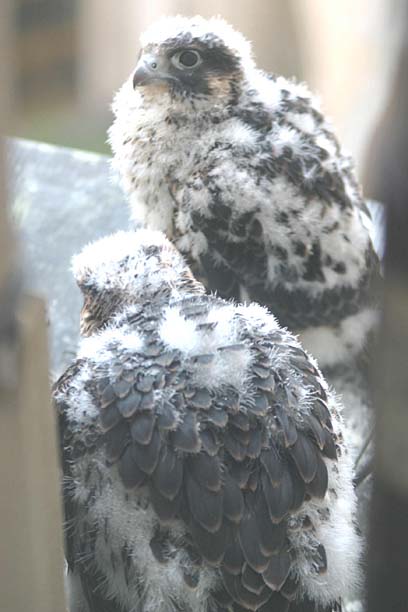
just about gone!
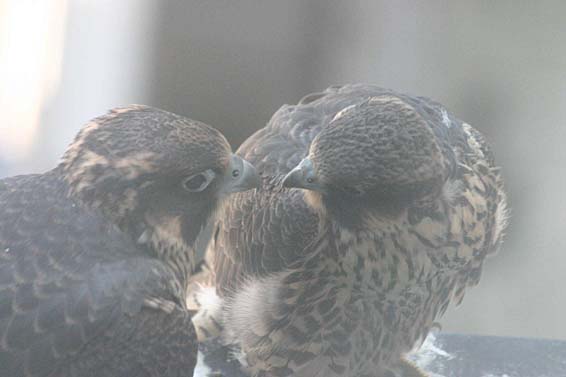
The down has been flying everywhere. This is SW.
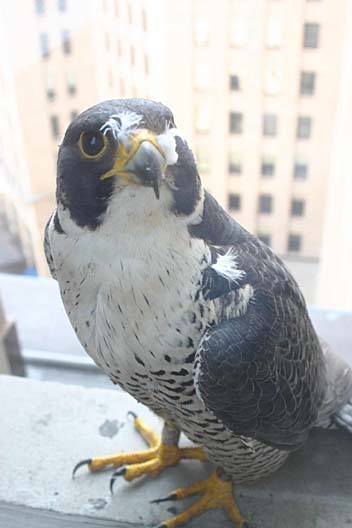
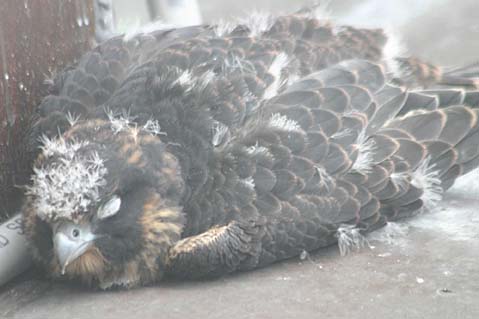
Unlike the adult’s slate blue feathers, juvenile feathers are brown.
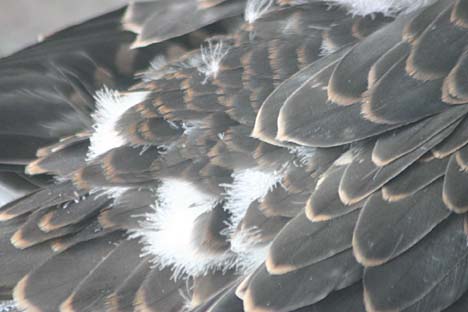
Wildlife biologist Marcel Gahbauer tells us: "Peregrines are admired for many reasons, but housekeeping is generally not one of them! Like with most aspects of their behaviour, there is considerable variation among individuals, but generally they let things lie where they land - whether feathers, bones, etc. By the end of the season, the nest area can be VERY messy! The best one can hope for is a good wind to clean off the ledge a bit from time to time." Nest monitor, Mr. Wright, reports that the smell is pretty unpleasant as well.
Soon the juvenile falcons will be taking their first flight, and they walk and flap a lot to strengthen their muscles.
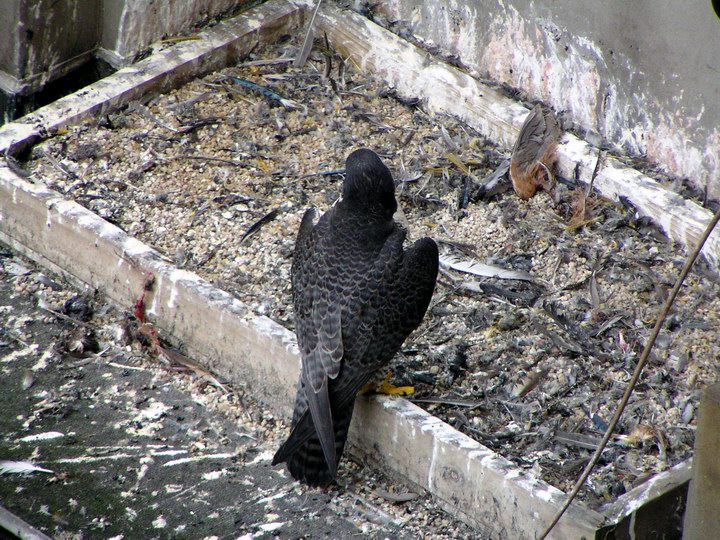
The first flight is called “fledging”. Sara Jean Peters, of the Ohio Division of Wildlife (retired) tells us:
“Like children learning to walk, flight is a series of experiments...some successful, some not.
Chicks typically exercise their wings, flapping in place, hopping and flapping, and running and flapping. If their nest is on a cliff, updrafts can actually catch under the extended wings and lift the birds up into the air and to a higher ledge. There are updrafts in the city as well, although the ledges aren't as numerous.
A chick that flushes from the ledge and takes flight too early may end up on the ground...a risky place in the city as well as at the foot of a cliff. It takes more muscle power to fly UP than out. Muscle development comes with age and exercise. The first flight made by an older chick will probably be more successful than that made by a younger chick. Landings, a very important part of flights, take lots of practice regardless of age!”
All that flapping and walking can make a young falcon tired.
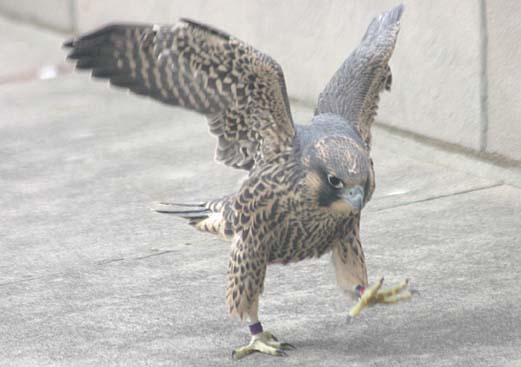
These big kids still call constantly to their parents for food, but soon they will learn to fly and begin to learn hunting skills.
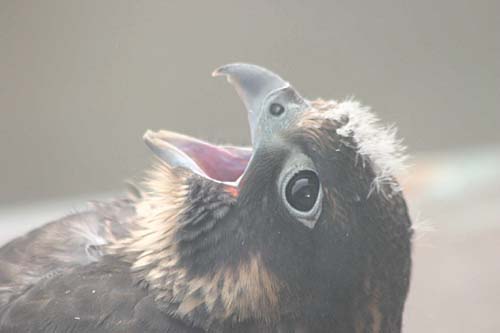
Stay tuned for fledging news……….
To watch the falcons live go to: http://www.falconcam-cmnh.org/news.php Our thanks to the Cleveland Museum of Natural History for sponsoring the FalconCams.
Photos are courtesy of Scott Wright, volunteer peregrine nest monitor. They may be used in any non-commercial publication, electronic or print, but please give photo credit.
Click here to read what happened next
