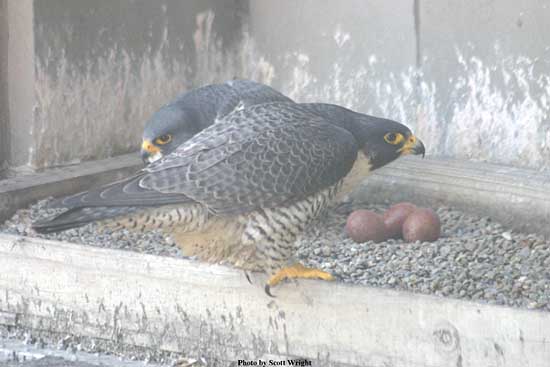
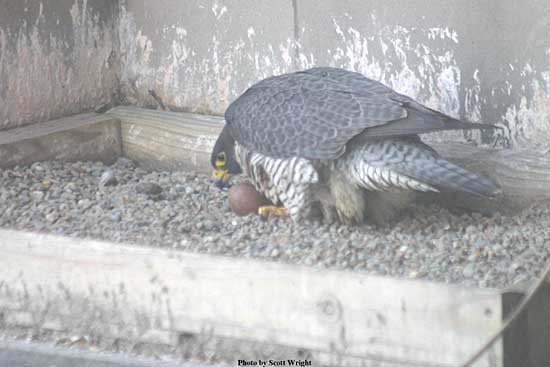
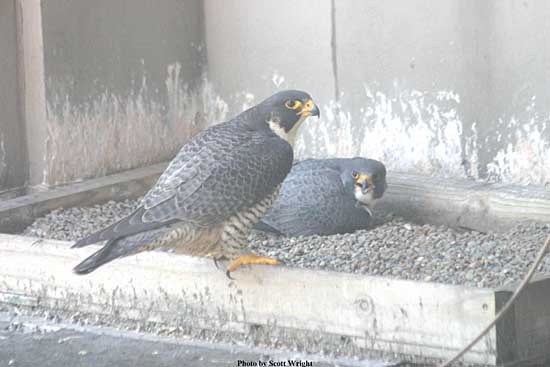
SW and Buckeye are spending Earth Day waiting for their chicks to hatch. Last year, the fourth egg was laid on March 19th and the first hatch was April 18th. This year, the fourth egg was laid on March 26th. When do you think the first chick will hatch?
If you have been watching SW and Buckeye as they incubate their eggs, you may have wondered about their lives. Because the peregrine falcon was on the List of Endangered Species for 30 years, many birds are banded and their life histories are known. SW was hatched and fledged from the 37th floor of the Gulf Tower building in Pittsburgh, PA in 1999. Pennsylvania does not believe in naming wild creatures, so she goes by her band letters, SW. Buckeye was hatched on the Rhodes State Office Tower in Columbus, Ohio in 1996. See if you can find these cities on a map of North America. Can you figure out how far SW and Buckeye had to fly to meet each other in Cleveland, Ohio?
Some experts think that the average life expectancy of the peregrine is only 4 to 5 years, while others say 10 to 12 years, but some records show a few wild birds that have nested for as many as 17 consecutive years. Most falcon chicks have a hard time surviving their first year or two of life, but once they reach maturity they may live a long time.
It's hard to see on the FalconCam, but you can look for tiny cracks on an egg that is about to hatch and a "pip", which is a small hole that the young bird inside the egg has made with its special egg tooth. The chicks will be hatching soon, so keep your eyes and browser set on: http://www.falconcam-cmnh.org/news.php
SW and Buckeye wait……
Scott Wright, volunteer nest monitor for the Ohio Division of Wildlife, offers the following hatching information: "Look for an eggshell, but do it quick as the female will often eat the eggshell, and move the shell about, often picking it up with her beak. Yes, eggs can hatch out during the night. The process can take some time if not aided by the parents - the hairline cracks will indicate that a hatch is under way."
Right now you may be seeing several signs that point towards hatching. In the last few days, the female often does not want to leave the nest and chases the male away if he offers to take over incubation. You may also notice that the parents sit on the eggs with their backs arched, and sometimes they seem to be listening to their eggs. Are the little chicks peeping inside???
Our thanks to the Cleveland Museum of Natural History for sponsoring the FalconCams.
Photos are courtesy of Scott Wright. They can be used in any non-commercial publication, electronic or print, but please give him photo credit.
Celebrate National Environmental Education Week and Earth Day April 15-22. For more information visit: http://www.eeweek.org/