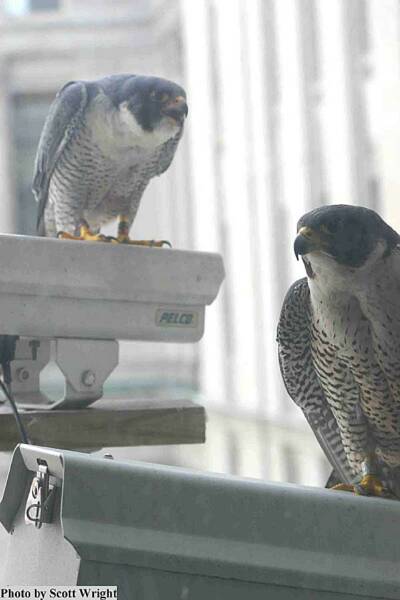
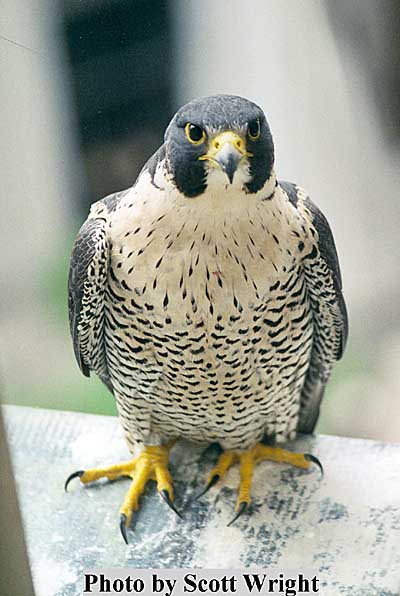
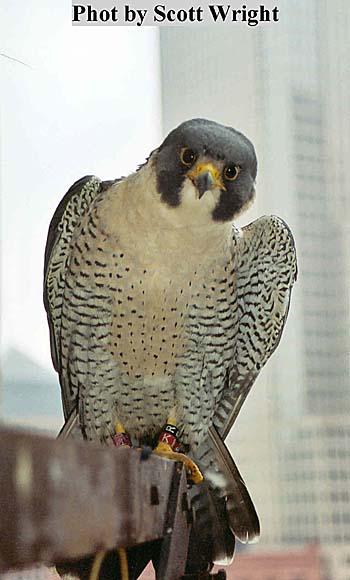
Can you tell which bird is SW (mom) and which one is Buckeye (dad)?
When the male and female peregrine are together, the biggest clue to tell them apart is their size difference. Female peregrines, as in most species of raptors, are much larger than males, about a third heavier. While the males and females have similar appearance, there are individual differences.
SW is larger, and she is also darker grey. SW has a somewhat speckled chest, while Buckeye's chest is more white. Buckeye has a gray “helmet” and no white cheek patches. If you can see their bands, compare the USFWS bands on their right legs; SW's is silver and Buckeye's is purple.
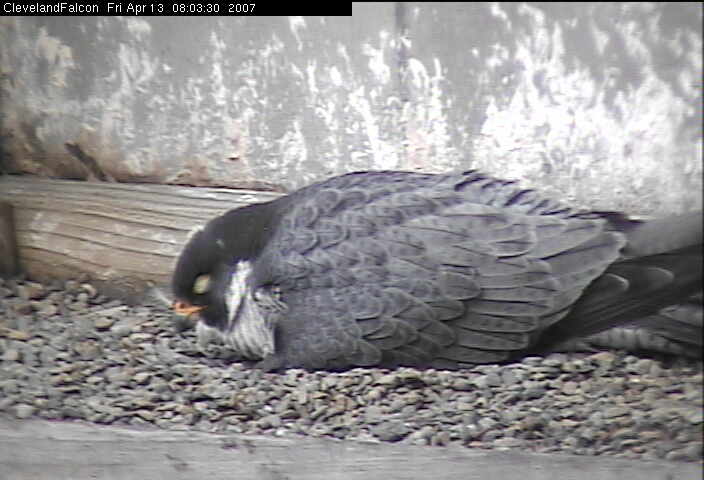
Our thanks to the Cleveland Museum of Natural History for sponsoring the FalconCams and for the FalconCam still.
Photos of SW and Buckeye are courtesy of Scott Wright. They can be used in any non-commercial publication, electronic or print, but please give photo credit.
Photos from the Apollo 11 Mission are courtesy of NASA. For more information visit: http://www.nasa.gov/
For more information about identifying peregrine falcons, visit the Canadian Peregrine Foundation at:
Next week is National Environmental Education Week, the largest organized environmental education event in U.S. history, culminating with Earth Day on April 22. As we watch the falcon family, we are reminded that the species peregrine falcon had nearly become extinct in North America because of the use of a pesticide called "DDT". Young scientists might like to look at the life of Rachel Carson, a writer and scientist who wrote a famous book called Silent Spring in 1962 that alerted people to the dangers and consequences of the use of pesticides. It is thanks to scientists such as Rachel Carson and concerned citizens that DDT was banned in North America in 1972 and whole species including peregrine falcon, bald eagle and bluebirds have escaped extinction. For more information visit: http://www.rachelcarson.org/
What is this picture doing in the Falcon Flash?
On July 20, 1969, astronaut Neil Armstrong was the first human to set foot on the moon and his first words were, "the Eagle has landed." The Eagle was the name of the Apollo 11 spacecraft, named after America's national symbol.
But in 1969, the species bald eagle, just like the peregrine falcon, was nearly extinct in the U.S. because of DDT. It, too, has recovered from near extinction. This year, a pair of bald eagles is nesting in Philadelphia (capital of the United States in its early history ) for the first time in more than 200 years. For more information visit: