FALCON FLASH
Dateline: Cleveland, Ohio
April 9, 2007
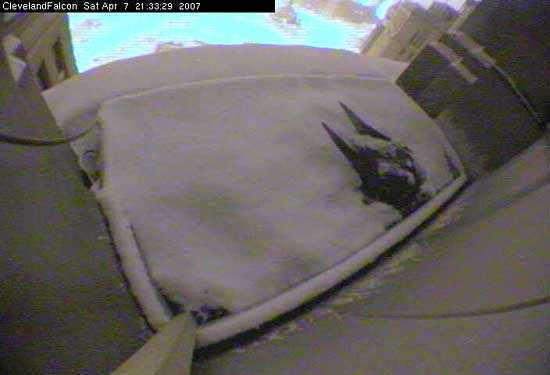
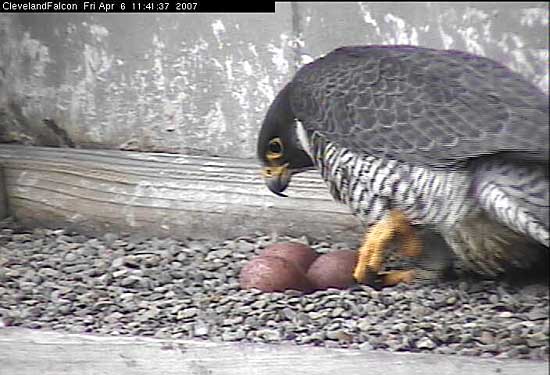
The Easter Bunny brought snow to Cleveland this year. In the following picture, Buckeye covered his precious eggs throughout the night to keep them warm and dry …..
The World Center for Birds of Prey in Boise, Idaho explains this interesting bird behavior: "Birds rotate their eggs to keep the eggs evenly warm or cooled (depending on weather). If the clutch is large, then the eggs on the outside are moved into the center of the clutch where the temperature maybe a few degrees higher. Eggs are also rotated to prevent the developing embryo from prematurely sticking to the inner membrane of the egg. If the egg stays in one position for too long, then the embryo can stick to the inner membrane. This may cause the embryo to develop or hatch improperly.
You could dissect a chicken egg to reveal the basic components of the egg. Most ornithology books will explain the anatomy of the egg. A store bought egg will do. The eggs are not fertilized, so may not show all components of the egg. Break the shell open gently and pour onto a smooth surface. You will also want to look at the eggshell, so don't destroy it.
If you have a dissecting microscope you could see the pores on the outside of the eggshell. This is where gas exchange occurs. Oxygen goes in and carbon dioxide goes out.
Have fun."
The Peregrine Fund, located at the World Center for Birds of Prey, led the way to save the species peregrine falcon. Falcon lovers owe our gratitude to this organization for the survival of the peregrine in North America. Today they continue working to save birds of prey around the world. Visit them at: http://peregrinefund.org/
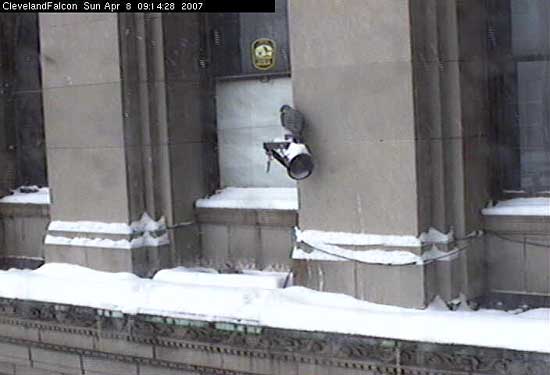
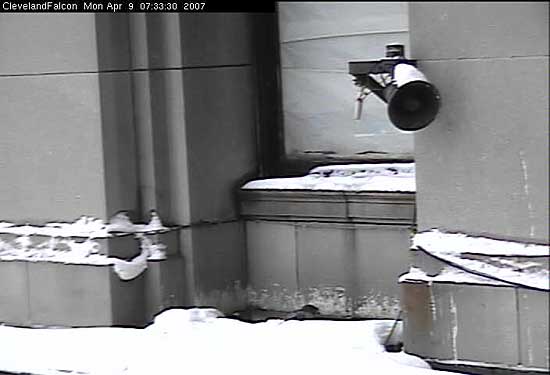
With a snowdrift in the nest, it looks bad, but the eggs should be OK.