Congratulations to SW and Buckeye on the successful hatching of 2 chicks in 2007!
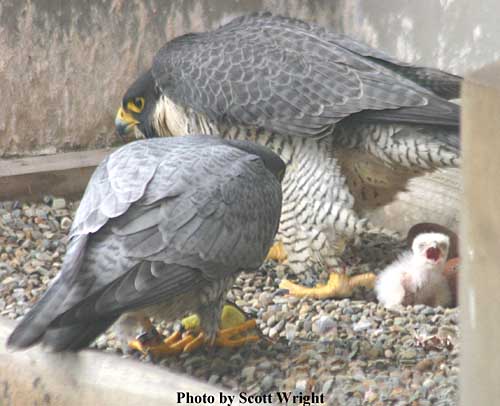
First there was one ........
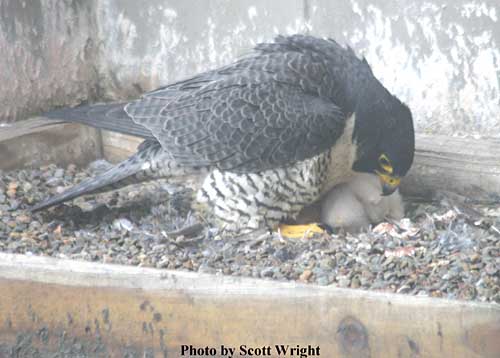
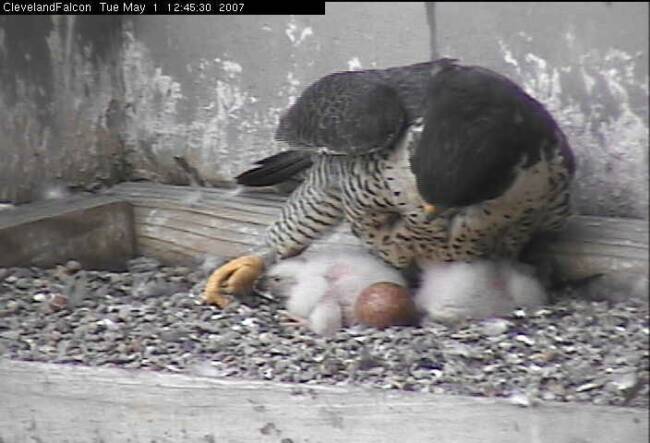
Mr. Harvey Webster, Director of Wildlife Resources at the Cleveland Museum of Natural History tells us: “With the thunderstorms and sometimes heavy rain (during the second hatch), it is a tribute to S/W and Buckeye that they can create a warm and dry sanctuary for the chicks and the remaining egg with their own bodies. The parents, in brooding the chicks, provide a source of warmth. In fact the temperature closest to the brood patch on S/W's abdomen might be close to 100 degrees F. The brood patch is featherless and highly vascularized to provide maximum surface area for heat transfer.
Then there were two …….
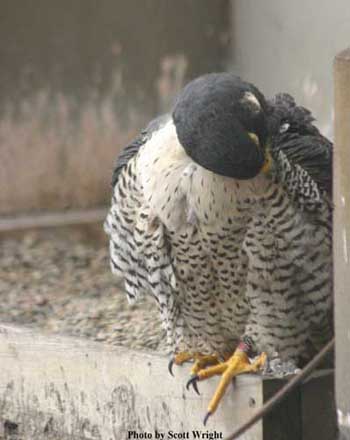
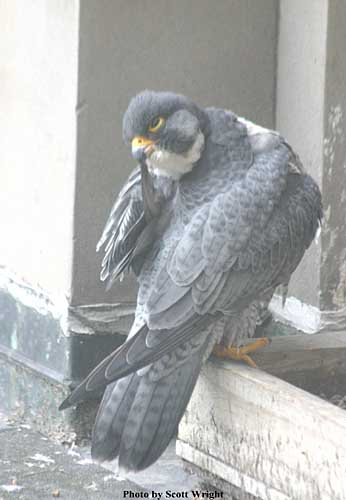
Buckeye preens……
Even in heavy rain, the water repellency of feathers is very effective. In part, this water repellency comes from the daily preening of the feathers. As the adults preen their feathers, restoring their velcro-like vanes and streamlining their order, the birds will pinch a small nipple like gland above the tail called the uropygial gland with their beaks. This gland secretes a combination of waxes and fatty acids that, when distributed on the feathers during preening, confer water repellency to the feathers. As a result water beads up on the feathers and rolls off the bird's back without soaking the feathers or down.”
Mr. Wright tells us, “Feathers are a bird's pride and joy and often they will do feather maintenance before they eat or drink”.
SW preens…….
Mr. Wright reports:
"The chicks will spend a great deal of time sleeping and huddled together for warmth. What to look for..... You want to see each kid with two wings, two legs, two eyes and a beak, you also want to see the "begging response", any time a parent is near...... The parents will cover (mantle) the young for 4-7 days. The young are not able to control body temperature (self-regulate) for about a week, if it stays chilly."
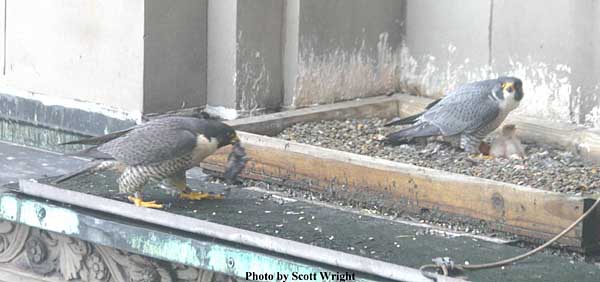
SW brings food to the family…...
Here's some information about feeding the chicks from wildlife biologist Marcel Gahbauer: "For the record, the chicks at a young age already scream for food incessantly, regardless of how recently they have been fed. This will only increase, and eventually you will see both adults away from the nest most of the time, for as long as one or the other is present, the chicks will be clamouring for food from them, even if they have none."
The chicks will grow and change very fast for the next 6 weeks. Check out a picture guide and information about chick growth at The Canadian Peregrine Foundation: http://www.peregrine-foundation.ca/info/ageguide.html
Our thanks to the Cleveland Museum of Natural History for sponsoring the FalconCams and for the FalconCam still.