FALCON FLASH
Dateline: Cleveland, Ohio
May 6, 2007
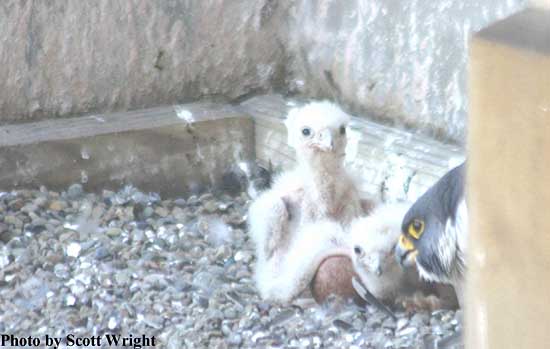
This year, only 2 of SW and Buckeye’s 4 eggs have hatched. Mr. Harvey Webster, Director of Wildlife Resources at the Cleveland Museum of Natural History tells us:
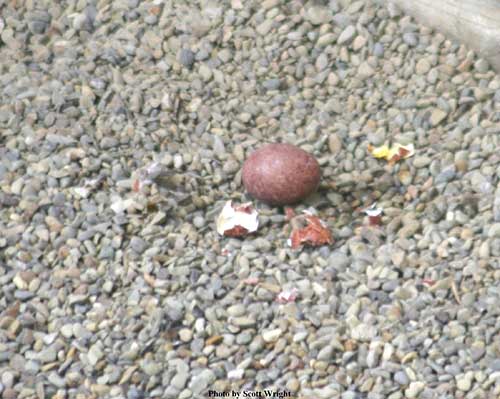
“The remaining egg is most likely the first egg that S/W laid.
Scenario #2: There was an inherent structural deformity in the egg. The formation of the egg in the oviduct of the female is an extremely complicated and resource intensive process. All of the ingredients needed to cook up one new peregrine falcon chick have to be assembled and neatly packaged in a supremely well-designed calcium carbonate container. And this packaging is accomplished in roughly 24 hours. Disturbance to the female at this time or internal challenges, such as pesticides, age, disease, or poor quality diet, could compromise the process of forming the shell. The resulting egg lacks the necessary structural integrity and collapses under the weight of the female as she attempts to incubate.
Do any of these attributes apply to S/W? Age – no, she is in her reproductive prime. Disease – no, she seems to be very fit and active. Diet - no, she is dining on the finest songbird selection a Peregrine Falcon could hope for.
Pesticides or other environmental contaminants are always a possibility with Peregrines. After all it was DDT and other organochlorine pesticides that endangered Peregrine Falcons in the first place. Though DDT was banned over 30 years ago, it is still present in the environment although not at levels that threaten Peregrines. Other toxins like PCBs are a constant threat. New threats are cropping up. For example, polybrominated diphenyl ethers (PBDE), chemicals widely used as flame retardants, have been identified in Peregrine Falcon eggs in Sweden, Greenland and elsewhere, far from the original source or use of the chemical. What effect these contaminants might have on Peregrines is not well understood.
In S/W’s case however, there is nothing in her past history to suggest any difficulty in producing healthy eggs. Quite the contrary, she has been downright prolific. And of course eggs 3 and 4 were successfully incubated to hatch. Perhaps some physical disturbance, passing trauma or environmental stress occurred after the laying of egg 1 that compromised egg 2. Or in the end perhaps egg 2 was simply a ‘bad egg.’
Whatever the scenario the fact that egg 2 collapsed beneath S/W was evident since at the time her abdominal feathers were soiled. The destruction of the egg clearly disturbed both parents, since they only intermittently attended egg #1 despite the sub-freezing temperatures on March 21st and 22nd. With the arrival of the third egg, incubation began in earnest but the embryo in egg #1 was already lost.
Though it is a disappointment that S/W and Buckeye will not have another 4 chick season, this is precisely why Peregrine Falcons have clutches of 3 or 4 eggs. This annual productivity compensates for the inevitable losses that occur with eggs, chicks, fledglings and juveniles. Clutch size is a balance between how many young the adults can successfully parent given available internal and environmental resources and the need to produce adequate numbers to sustain the population.
Will there be some evidence at the nest that might indicate what really happened to the mysterious egg #2? By now it is doubtful. So we might never know the real story.
What will happen to Egg #1? The egg will either pop from the gases formed by bacterial contamination internally, or break from the action among the chicks or adults. Or it might dry out inside and remain in the scrape. If present at banding time there, it can be recovered and examined.” Banding will be on May 15th.
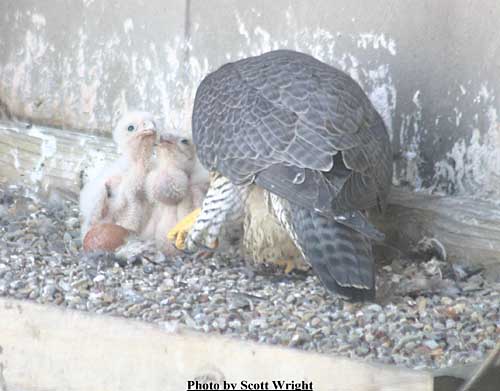
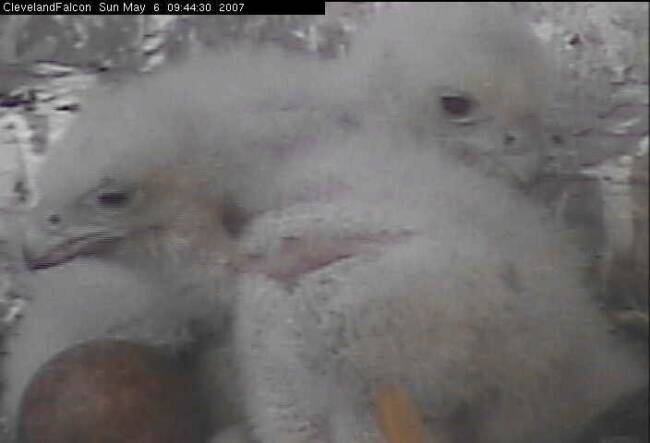
Watch carefully each day because the chicks are growing very fast! In the following picture you can see the chicks’ bulging crops on their necks.
Typically Peregrine Falcons do not commence incubation with the appearance of the first egg. Rather, they protect it from temperature extremes and wait until the second or third egg before they sit tight on the eggs and incubate in earnest. It generally takes 31.5 days from the onset of incubation to pip and then 24-36 hours from pip until hatch. The hatch times were consistent with active incubation applied with the arrival of egg 3 on March 23rd and egg 4 on March 25th.Typically Peregrine Falcons do not commence incubation with the appearance of the first egg. Rather, they protect it from temperature extremes and wait until the second or third egg before they sit tight on the eggs and incubate in earnest. It generally takes 31.5 days from the onset of incubation to pip and then 24-36 hours from pip until hatch. The hatch times were consistent with active incubation applied with the arrival of egg 3 on March 23rd and egg 4 on March 25th.
With the mysterious cracking of egg 2 on March 20 or 21st, one of the following scenarios most likely transpired.
Many bird species have this feature, which is a storage place for food. When a chick’s stomach is full, it can store extra food in its crop. The chicks will grow to the size of their parents in just 6 weeks, so they eat a lot!
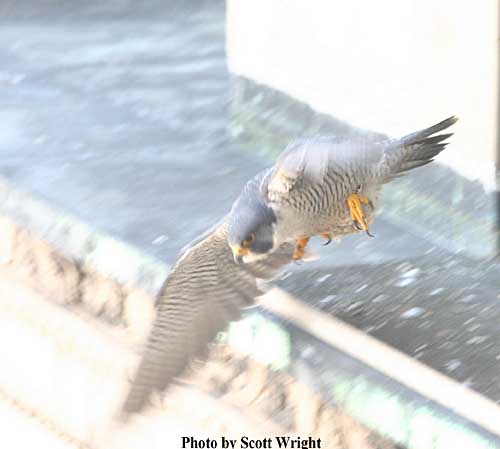
Buckeye is very busy these days hunting to feed his growing family.