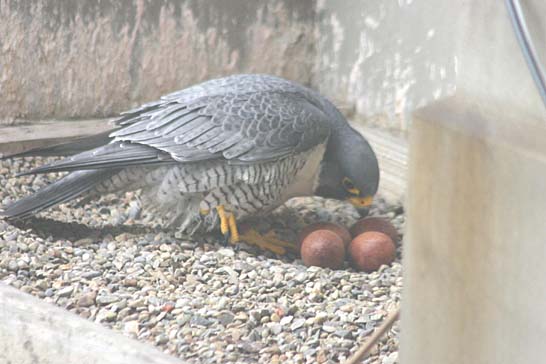
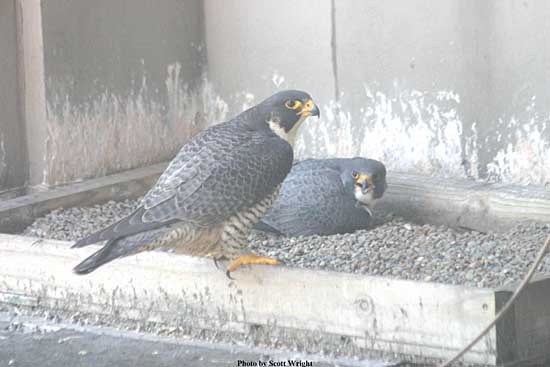
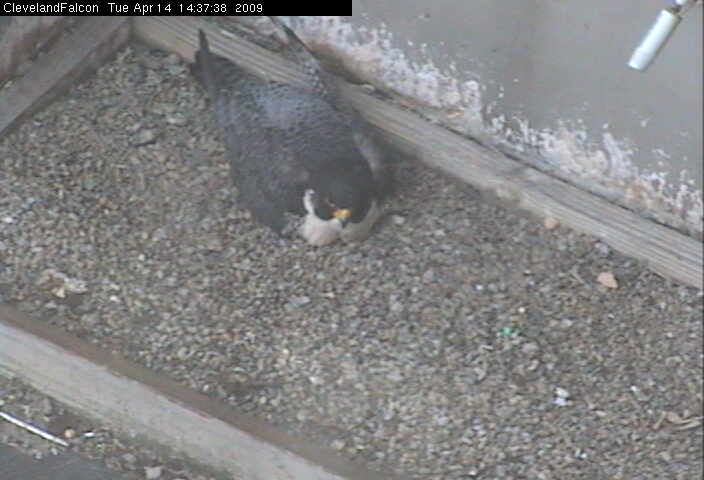
It is National Environmental Education Week, April 12-18, and Earth Day is on April 22nd. For the past few years, SW and Buckeye have helped us celebrate Earth Week with newly hatched chicks. This year the fourth egg was laid on March 18th, and incubation usually lasts 33 to 35 days from the date the last egg, or the second last, was laid. When do you think the first chick will hatch?
Mr. Scott Wright, volunteer nest monitor, offers the following hatching information: "Look for an eggshell, but do it quick as the female will often eat the eggshell, and move the shell about, often picking it up with her beak. Yes, eggs can hatch out during the night. The hairline cracks will indicate that a hatch is under way."
It's hard to see on the FalconCam, but you can look for tiny cracks on an egg that is about to hatch and a "pip", which is a small hole that the young bird inside the egg has made with its special egg tooth. According to Mr. Harvey Webster, Director of Wildlife Resources at the Cleveland Museum of Natural History, “It generally takes 24-36 hours between the onset of the pip and actual hatching. The parents do not assist in the hatching process. "
Right now you can look for signs that point towards hatching. In the last few days before the hatch, the female often does not want to leave the nest and chases the male away if he offers to take over incubation. You may also notice that the parents sit on the eggs with their backs arched, and sometimes they seem to be listening to their eggs. Are the little chicks peeping inside???
For more information about National Environmental Education Week visit: http://www.eeweek.org/
Our thanks to the Cleveland Museum of Natural History for sponsoring the FalconCams and for the still.
Photos are courtesy of Scott Wright, volunteer peregrine nest monitor. They may be used by children for school and/or personal projects, but please give Mr. Wright photo credit. All others must contact Mr. Wright directly for permission to use his photos.