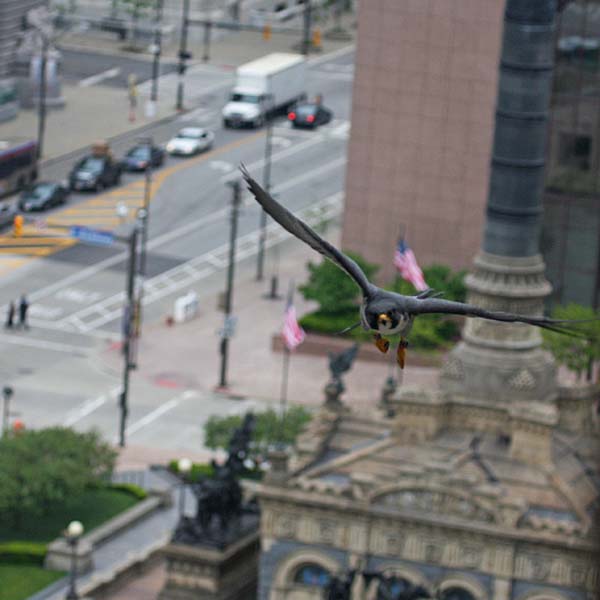
Here is an interesting falcon nesting fact from The Canadian Peregrine Foundation: "Historically, Peregrines were renowned for having remarkably stable populations. Records are best documented for Great Britain, where the breeding population remained steady around 800 pairs from the time of Queen Elizabeth I to the Second World War nearly 400 years later. Even more amazingly, some particular nest sites were almost continuously occupied throughout this period."
In the last 100 years in North America, peregrine populations have been drastically affected by human behavior. In the late 1800s, a popular hobby was collecting eggs from wild nests, and hundreds of chicks did not hatch as a result. Also, adult peregrines were captured for use in the sport of falconry. As the number of falcons began to decline, The Migratory Bird Treaty Act of 1918 was passed to help protect the birds from these human activities. A more serious threat occurred between 1950 and 1965 when peregrine falcon populations declined rapidly due to the effects of pesticides, particularly DDT, and the peregrine was near extinction by the 1970s. Use of DDT was banned in the United States in 1972.
DDT nearly caused the bald eagle, as well as other species, to become extinct. On July 20, 1969, astronaut Neil Armstrong was the first human to set foot on the moon and his first words were, "the Eagle has landed." The Eagle was the name of the Apollo 11 spacecraft, named after America's national symbol, but real eagles were disappearing in North America.