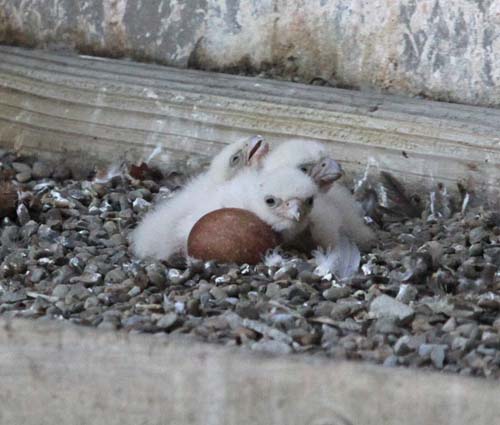
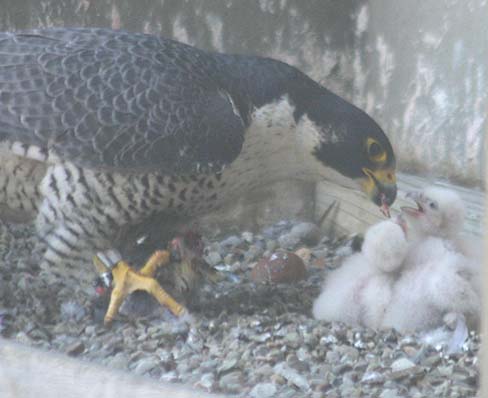
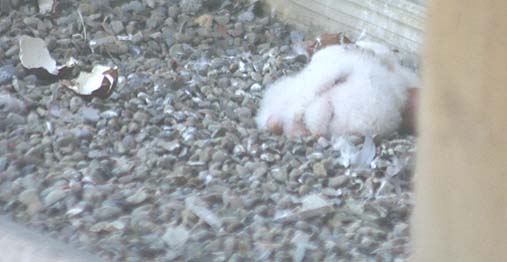
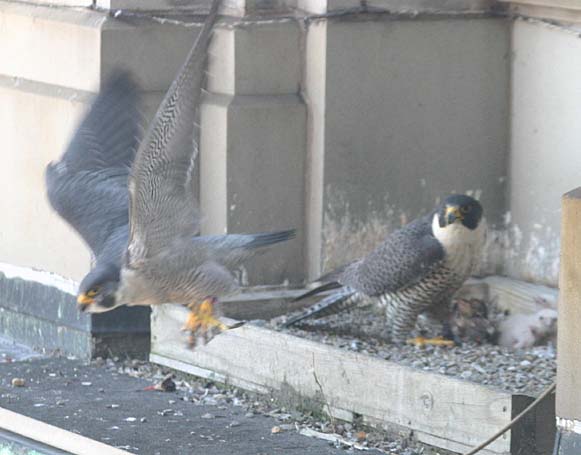
On Earth Day this year, SW and Buckeye were taking care of their 3 hungry eyases and wondering if the 4th egg would hatch.
Peregrine eyases grow at an incredible rate. By the time they are six weeks old they will be as big as their parents. Each week you will notice changes in their appearance and behavior. During the first week, the chicks can’t do much - except eat! SW spends most of her time keeping the chicks warm if the weather is cool, since they cannot regulate their body heat. Buckeye does most of the hunting and both parents feed the chicks; there are several feedings per day.
Nest monitors, Mr. Wright and Mr. and Mrs. Saladin, stopped by to watch. They report that the parents were making sure each chick got a good helping of food.
Our thanks to the Cleveland Museum of Natural History for sponsoring the FalconCams.
Mr. and Mrs. Saladin provided the first picture of 3 eyases and unhatched egg. Other photos are courtesy of Mr. Scott Wright.
Mr. Webster built the nestbox that SW and Buckeye call home and which has been the home of falcon families since 1991. It is one of the most successful nestsites in the United States with nearly 50 chicks hatched and fledged. Mr. Webster and the Cleveland Museum of Natural History have played an important role in helping the species peregrine falcon in its recovery from near extinction in the U.S. Visit the Museum’s website at: http://www.cmnh.org/
Mrs. Linda Foote, Instructional Technology Specialist for the Poway, California Unified School District, sends along an improved GoogleEarth program that shows a spectacular view of SW and Buckeye’s home in downtown Cleveland, Ohio which is. You will need to have GoogleEarth installed on your computer. can be download GoogleEarth at:
Mr. Harvey Webster, director of wildlife resources with the Cleveland Museum of Natural History, tells us that even with cold weather or heavy rain, “…..it is a tribute to S/W and Buckeye that they can create a warm and dry sanctuary for the chicks with their own bodies. The parents, in brooding the chicks, provide a source of warmth. In fact the temperature closest to the brood patch on S/W's abdomen might be close to 100 degrees F. The brood patch is featherless and highly vascularized to provide maximum surface area for heat transfer”.
Luckily for us, with recent warm weather, it has been easier to see the chicks uncovered.
The parents are very, very busy hunting for food and feeding the hungry eyases.