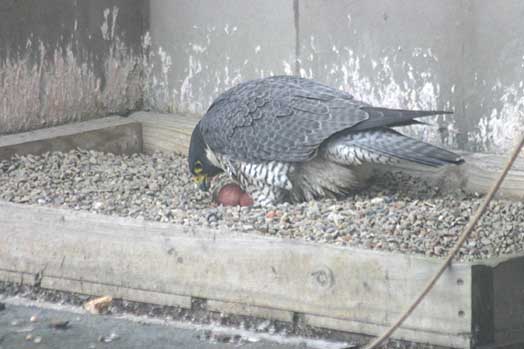
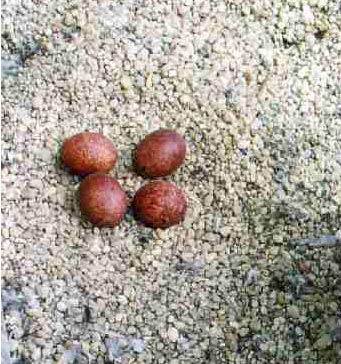
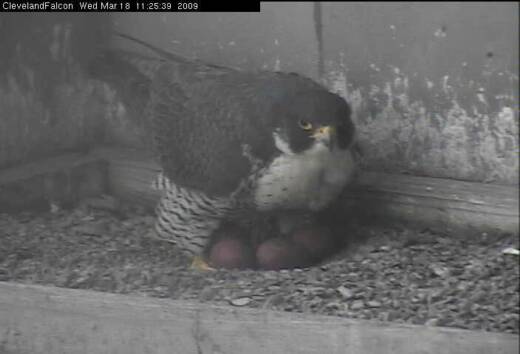
SW and Buckeye usually have 4 eggs, and most peregrines have three or four eggs. Some young females may produce less and some females may have five or even seven eggs, but it seems to be difficult for most peregrine parents to keep up with feeding more than 4 hungry growing chicks.
According to the Canadian Peregrine Foundation, incubation usually lasts 33 to 35 days from the date the last egg, or the second last, was laid. You can do the math and figure out approximately when the first chick will hatch. There is a lot of information available at the Canadian Peregrine Foundation at: http://peregrine-foundation.ca/
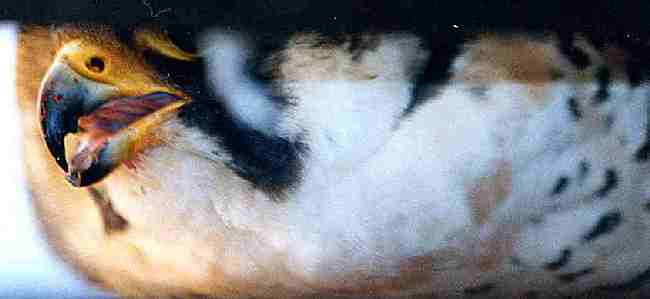
After each egg appears, volunteer nest monitor Mr. Scott Wright, tells us, “The male will smell his new egg to get its scent.... I once saw a male tasting the egg, opening up his beak and gently touching the egg with his tongue!!”
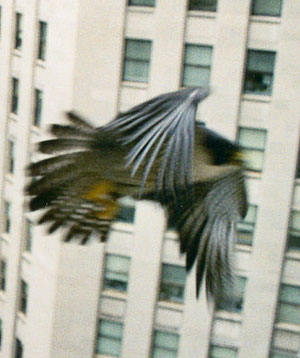
Peregrine falcons are fierce predators, and their prey is other birds. One of the main reasons they have moved into cities is because there are so many birds available to hunt year-round. Peregrines dive for their food, a method that allows them to achieve great speed. A straight-down dive with wings folded to the sides is called a "stoop", and speed may reach 200 miles per hour (320 km/h) or more. It’s hard to get a picture of a bird flying this fast, but here’s one caught at the beginning of a stoop.
The following National Geographic clip shows incredible footage of a peregrine named Frightful as she flies and dives:
Our thanks to the Cleveland Museum of Natural History for sponsoring the FalconCams and for the still.
Photos are courtesy of Scott Wright, volunteer peregrine nest monitor. They may be used by children for school and/or personal projects, but please give Mr. Wright photo credit. All others must contact Mr. Wright directly for permission to use his photos.
It is Buckeye’s job to hunt and bring back food for SW. Here is description of a hunting dive (a "stoop") from an eyewitness: "Saw Buckeye in a stoop. He went past my office window in an absolute vertical dive at a speed that startled me. It occurred at a moment (split second) that I happened to be glancing out the window at the lake. He missed his intended target, which I never saw, and flew to the top of the Marion Bldg. on West 3rd. Street. He stayed there for about three minutes and then flew to the roof of the Justice Center. I can only say that this bird's speed was incredible---like a bullet shot!!! I know their speed is estimated to be approximately 200MPH--but to actually see it is an incredible experience. I believe it was Buckeye based only on the size of the falcon."
Mr. Scott Wright, who has monitored this nestsite for many years, adds: "Actually, the speed is more like 250mph! I had a radar gun lent to me by MPH, (a company in Kentucky that makes radar guns for the police) and I had the gun for two years. I had Szell (an earlier male peregrine falcon at this nestsite) at over 250mph."
The falcon uses its talons to strike and/or grasp the prey in flight, and the impact is usually strong enough to kill the prey instantly. After the prey has been struck (people who have witnessed a strike say it looks like an explosion of feathers) the peregrine must catch the prey as it falls. If the prey is not dead, peregrines will bite the neck of the victim to finish it off, and they have a special notch in their beak for this purpose.