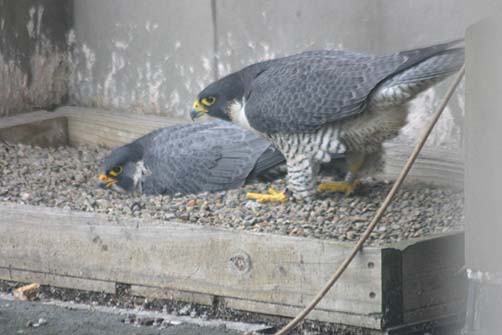
It looks like SW has finished laying eggs - we hope all 4 will hatch.
SW and Buckeye are wonderful parents. As you monitor the FalconCam during incubation, you will almost always see a parent covering the precious eggs. A typical day in the life of SW and Buckeye during incubation finds SW doing most of the egg-sitting, as the female usually sits on the eggs for most of the day and throughout the night. Buckeye will sit on the eggs for a few hours each day so that SW can go out and stretch her wings. Most importantly, Buckeye will catch food and bring it to SW.
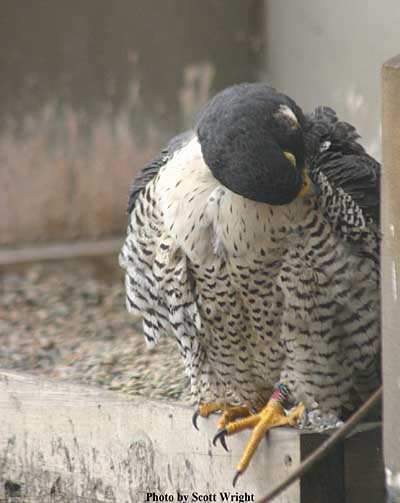
In the next picture, SW takes a mini-break to clean her feathers. This important bird activity is called “preening” and must be done to keep feathers clean and healthy. Volunteer nest monitor, Mr. Scott Wright, tells us, “Feathers are a bird's pride and joy and often they will do feather maintenance before they eat or drink”.
Mr. Harvey Webster, Director of Wildlife Resources at the Cleveland Museum of Natural History tells us, “Even in heavy rain, the water repellency of feathers is very effective. In part, this water repellency comes from the daily preening of the feathers. As the adults preen their feathers, restoring their velcro-like vanes and streamlining their order, the birds will pinch a small nipple like gland above the tail called the uropygial gland with their beaks. This gland secretes a combination of waxes and fatty acids that, when distributed on the feathers during preening, confer water repellency to the feathers. As a result water beads up on the feathers and rolls off the bird's back without soaking the feathers or down”.
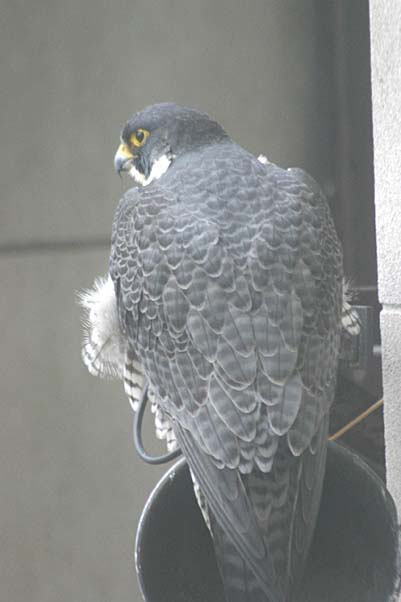
Aren’t SW’s feathers beautiful?
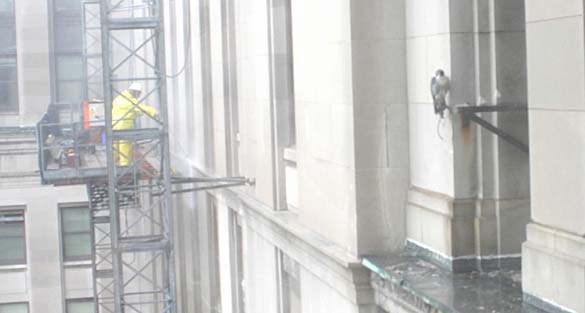
Falcon fans worry about human disturbance at the nest-site. SW and Buckeye are always watchful when humans are near, but they seem to be tolerant of human activity. Last week there was a very noisy St. Patrick’s day parade in downtown Cleveland, and each year there are even noisier 4th of July fireworks near their territory. There is also ongoing construction and maintenance on their skyscraper home.
Some peregrines aren’t so tolerant of humans. A female peregrine named “Ironton Lucy”, an Ohio neighbor of SW and Buckeye, became famous for her aggressive behavior toward humans. An up-close and personal encounter with Lucy is told by Mr. Cecil Townsend, a supervisor for the Ohio state highway garage. He tells of a sunny Friday afternoon when he went to check the navigational lights that hang from chains under a bridge that guide barge traffic on the Ohio River. He checked the lights on the Ohio side which were fine and then went on to the Kentucky side. After pulling the light up and then lowering it back, he walked 8-10 steps and was hit from behind. He dropped to his knees, saw stars and was disoriented for a few seconds. He didn't know what had happened and assumed he had been struck by a car, perhaps by a large side mirror. A lady in a car witnessed the event and was able to stop in time to keep from hitting him. As he gained his wits again, blood was gushing down his face and his glasses had been knocked off. He had three holes in the top of his head as well as the cut above his eye. He said he had to stick his fingers in the holes in the top of his head to stop the bleeding (that's how large they were from Lucy’s talons) and hold a T-shirt to the cut over his eye as he made his way to his vehicle and got himself to the hospital where he received stitches. He credits his glasses for saving his eye. When he returned to the bridge to investigate, he and others discovered there were peregrine falcons that had chosen the bridge as their nesting site and that fierce “Ironton Lucy” was defending her territory. Lucy became very well-known for her attacks to pedestrians crossing the bridge, and because of that, the bridge was closed to pedestrians during nesting season. While most falcons simply come close in their dives, Lucy was frequently known to make contact. Many falcon fans traveled across the state to see her as word of her boldness spread. Lucy is no longer with us and is presumed dead. Her body was never found but her leg-bands were recovered from within a steel beam on the bridge by workers. She has been replaced by another female that is not so aggressive. You can read about another encounter with Lucy at
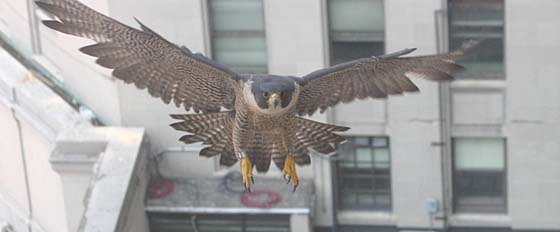
This picture of SW might help you to imagine what it is like to have a falcon coming toward you as she defends her territory.
To watch the falcons live go to: http://www.falconcam-cmnh.org/news.php Our thanks to the Cleveland Museum of Natural History for sponsoring the FalconCams.
Photos are courtesy of Scott Wright, volunteer peregrine nest monitor. They may be used by children for school and/or personal projects, but please give Mr. Wright photo credit. All others must contact Mr. Wright directly for permission to use his photos.