FALCON FLASH
Dateline: Cleveland, Ohio
May 13, 2009
For a wonderful video of banding day activities from the Cleveland Plain Dealer newspaper go to:
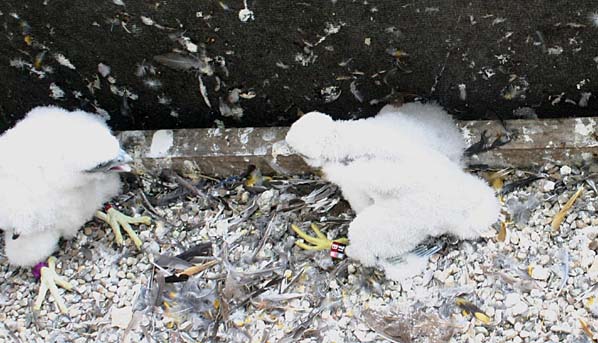
What a difference a few days make! On banding day, the 3 week old chicks had lots of down and were just beginning to test their wings…..
By now we are beginning to be able to tell which chick is which because of their size. Mr. Harvey Webster, Director of Wildlife Resources at the Cleveland Museum of Natural History, tells us: “As the … chicks grow, a size difference will become readily apparent between them, only it will be the female that is bigger. In most raptor species, the females are larger than males. In Peregrine Falcons, the males are called tercels or tiercels as they are one third smaller than the females. This is called reversed sexual size dimorphism, reversed because usually males are larger than females in vertebrate species.”
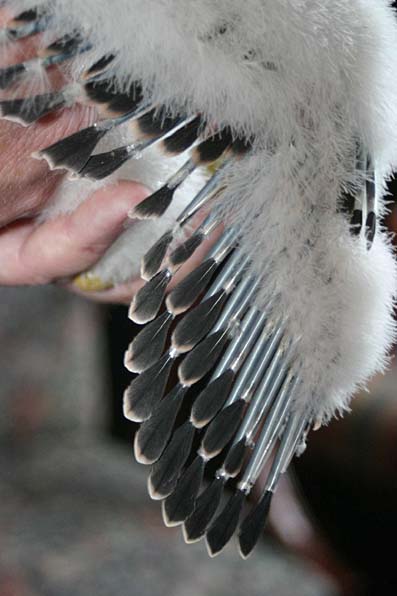
Besides size, the biggest change is the appearance of the eyases, as they lose their down and it is replaced by brown juvenile feathers. Here are Lunge’s new wing feathers.
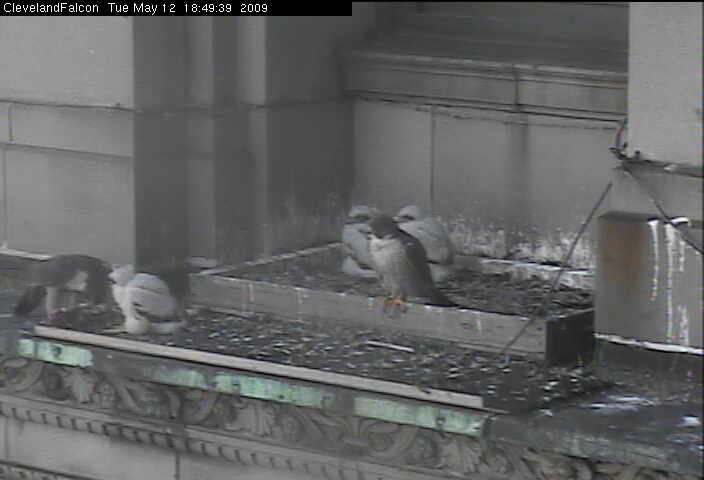
Less than one week later, the chicks are losing their down, they are out of the nestbox and almost as big as their parents!
With the successful hatching and banding of 3 eyases, it is a good time to remember the people who helped save the species peregrine falcon from near extinction. Thanks to dedicated biologists and citizen volunteers across North America, today we are able to watch a successful nestsite where peregrine falcon eggs hatch and chicks grow to be adults, but this was far from reality 40 years ago. By 1970, due to the use of the pesticide DDT which caused eggshells to thin and eggs to break, peregrine falcons were going extinct in North America. One of the most important people that helped saved the species peregrine falcon - as well as other species such as the bald eagle - was Rachel Carson, a wildlife biologist and author. In her book, Silent Spring (1963), she warned Americans of the danger of pesticides, especially DDT. This book was a wake-up call that helped lead to the banning of DDT in the U.S. and Canada in the early 1970s. Today, there is a skyscraper named in her honor, the Rachel Carson State Office Building in Harrisburg, Pennsylvania, and peregrine falcons nest on this building. To learn more about Rachel Carson, go to: http://www.depweb.state.pa.us/heritage/cwp/view.asp?A=3&Q=442627
Watch the FalconCams closely to watch the chicks grow at:
Photos are courtesy of Scott Wright, volunteer peregrine nest monitor. They may be used by children for school and/or personal projects, but please give Mr. Wright photo credit. All others must contact Mr. Wright directly for permission to use his photos.