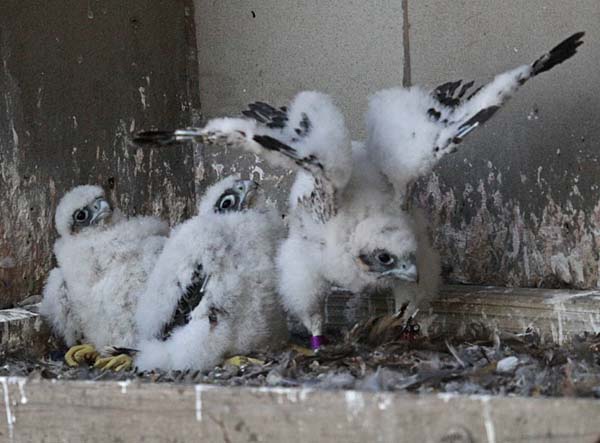
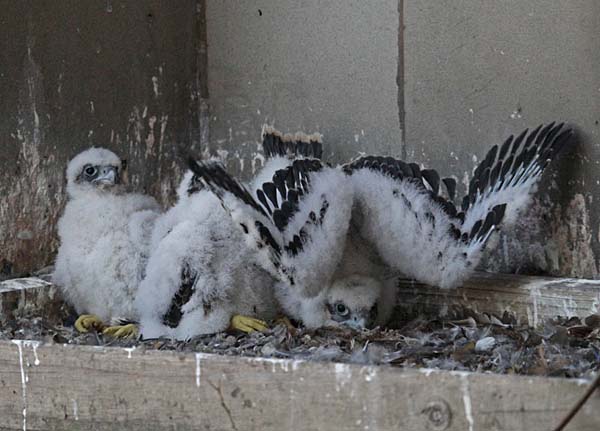
A recent visit to the nest by volunteer nest monitors, Mr. and Mrs. Saladin, caught Strike thinking of flying. “Strike was doing some flapping and wing stretches, which was comical to watch because she would occasionally lose her balance when her wings were above her head and would fall forward”.
Over the past 40 years, dedicated biologists such as Mr. Harvey Webster of the Cleveland Museum of Natural History and citizen volunteers such as Mr. Wright and Mr. and Mrs. Saladin have helped the species peregrine falcon recover from near extinction. This recovery has been one of the great success stories of wildlife conservation. By 1970, due to the use of the pesticide DDT which caused eggshells to thin and eggs to break, there were only 39 known pairs of Peregrine Falcons in the lower 48 states and the species had gone extinct east of the Mississippi River. In an earlier Falcon Flash, Mr. Webster talked about Dr. Tom Cade and called him the “dean of falcon biologists”. Dr. Cade, a professor of ornithology at Cornell University, and other scientists had the idea to try to save the species through a breeding program, but in 1970 only a handful of peregrine falcons had ever been successfully bred in captivity in the world and none had been successfully released to breed in the wild. Dr. Cade remembers: "When we began the recovery effort in 1970 many people felt it couldn’t be done. Since it was the first time a recovery effort of this magnitude had ever been undertaken, I also wondered if we would ever see this day. It wasn’t until 1980 when released falcons returned and successfully fledged young that I really knew we had overcome the large challenges and we could succeed”. Most important to the recovery of the species, DDT was banned in the U.S. and Canada in the early 1970s.
Here is a picture from a book by Dr. Cade showing a chick hatching in the captive breeding program.
More than 4,000 captive-reared birds were released in 28 states over a 25 year period, leading to the recovery of the species, and Dr. Cade founded The Peregrine Fund which led the way. These efforts resulted in breakthroughs in endangered species research and to the recovery of other species including the Bald Eagle. The Peregrine Fund now works throughout the world to save species.
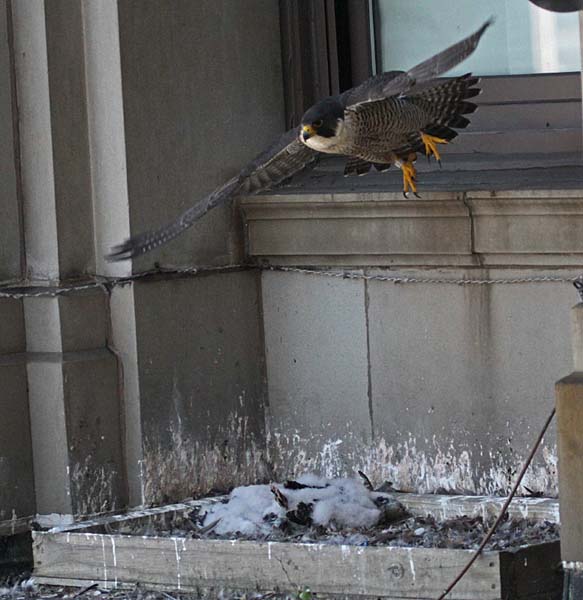
Today we are able to watch a healthy family of peregrines. As you can see, the chicks are getting very large, and such big eyases need a lot of food. The parents are very busy hunting for and feeding the eyases.
Our thanks to the Cleveland Museum of Natural History for sponsoring the FalconCams and for the still.
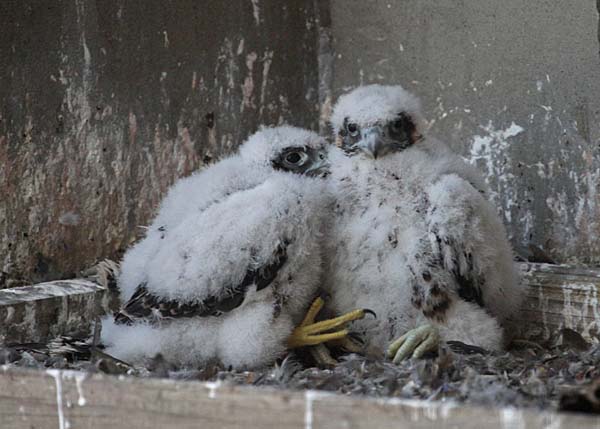
Today’s photos come from Mr. and Mrs. Saladin, volunteer peregrine nest monitors who are helping Mr. Wright.
In the following picture you can see individual differences between the eyases. Mr. and Mrs. Saladin report: “Cirrus is the one with the more yellowish feet, as you can see in comparison with Strike to Cirrus' right. You can see how much thicker the female's toes are with their feet so close together”.