


FALCON FLASH
Dateline: Cleveland, Ohio
May 11, 2011
SW and Boomer’s eyasses were banded today by the Ohio Division of Wildlife. Because peregrine falcons were on the List of Endangered Species for 30 years and because they are still rare, the birds are banded so that they may be tracked and studied in the future. Our thanks to the Ohio Division of Wildlife for their care of the species.
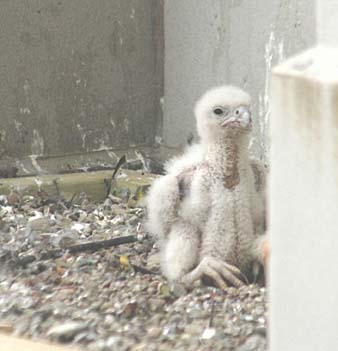
Here are SW and the eyasses just before banding. Notice how big they are getting.

Click here to read what happened earlier
Thanks to an eyewitness falcon fan, we have video of the events. Here is the “chicknapping” where humans took the eyasses out of the nestbox while the SW and Boomer did a series of divebombs at the humans: http://s286.photobucket.com/albums/ll108/bobbytimewarp/?action=view¤t=MVI_0217.mp4
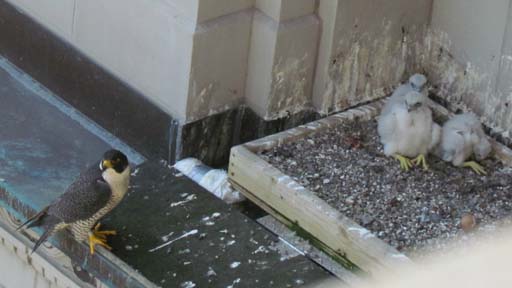
This year the steel “drawbridge” malfunctioned and was not raised at the edge of the nestbox. This caused falcon fans to worry that the eyasses might panic and fall over the edge, but all went well.
First, a human stepped into the nestbox …..
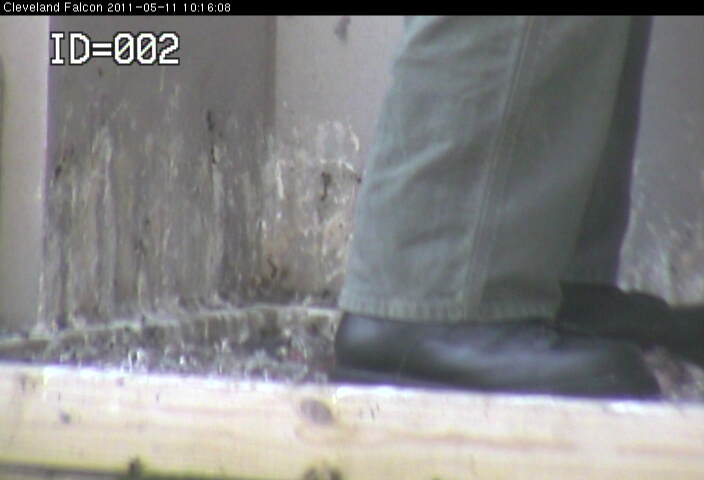
and the parents were very worried……..
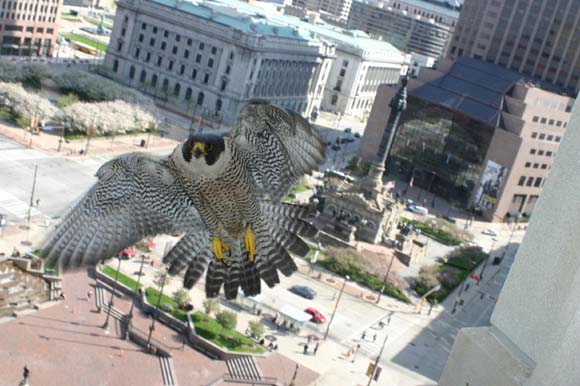
The Ohio Division of Wildlife biologists took blood samples, checked over the eyasses, determined their sex, and bands were attached to their legs. Here they are:
There are 2 females and 1 male:
76/D, female, "Soarer"
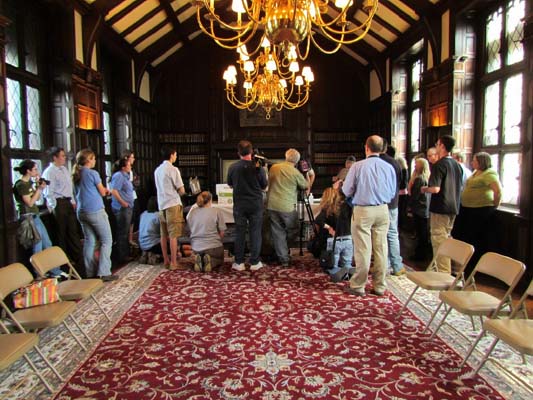
in a box…..

The last video shows the eyasses being returned to their nestbox after they were banded:
You can see how big the eyasses are getting! Mr. Harvey Webster, director of wildlife resources with the Cleveland Museum of Natural History, tells us: “This is a time of extraordinary growth for the chicks. They have voracious appetites. As an example, when we were raising young Bald Eagles at the Museum’s Perkins Wildlife Center, we would typically offer the chicks 10% of their body weight in food at each feeding and feed them on average 5 times per day. In the first two weeks of their life the chicks would have a net daily weight gain of 20%, doubling their weight every 5 days! That extraordinary increase in size diminishes after 2-3 weeks. A similar growth rate is seen in Peregrine Falcons………. A useful feature found in many species of birds (for when your eyes are bigger than your stomach) is a crop – a thin walled sac off the esophagus. Even after the stomach is filled during a meal, the bird can continue to eat. The extra food is stored in the crop. Then as the food in the stomach is digested, the food in the crop is moved to the stomach. This is particularly apparent in the downy young Peregrines. After a feeding by the parents the crops of the chicks will bulge outward just above their chests”………….
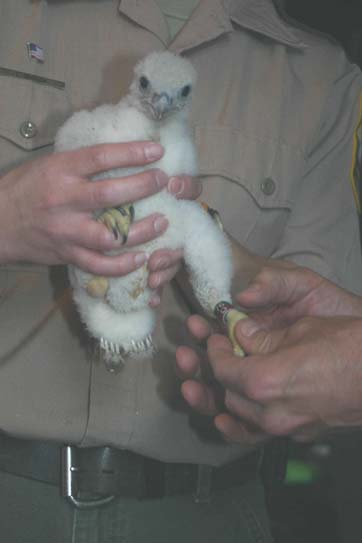
75/D, female, "Savvy"
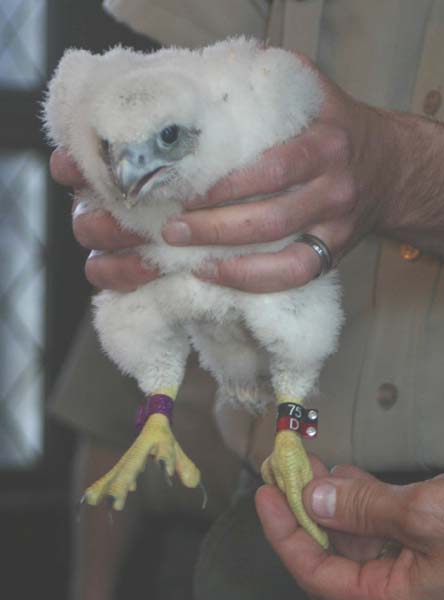
32/B, male "Spark"
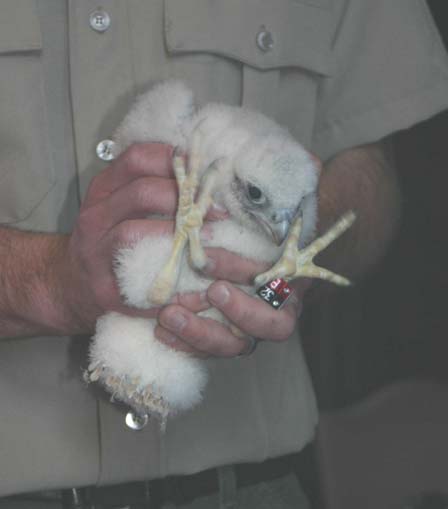
You can see on the videos that the eyasses are now able to move around the nest. At first, they walk on their tarsi (heel bones). Later on, they will begin to walk on their toes, as adult birds do.
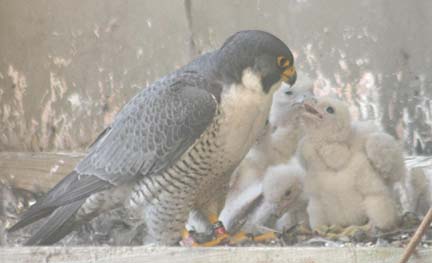
Thanks to falcon fan Bobby for the first picture of the chicks before banding and for the great videos. All other photos are courtesy of Scott Wright, volunteer peregrine nest monitor. They may be used in any non-commercial publication, electronic or print, but please give photo credit.
To watch the falcons live go to: http://www.falconcam-cmnh.org/news.php Our thanks to the Cleveland Museum of Natural History for sponsoring the FalconCams and for the still of the human foot in the nestbox.
Click here to read what happened next
