


FALCON FLASH
Dateline: Cleveland, Ohio
May 8, 2011
Ohio Division of Wildlife biologists will be banding the eyasses on Wednesday, May 11 in the morning. Send your name suggestions today if you haven’t already.
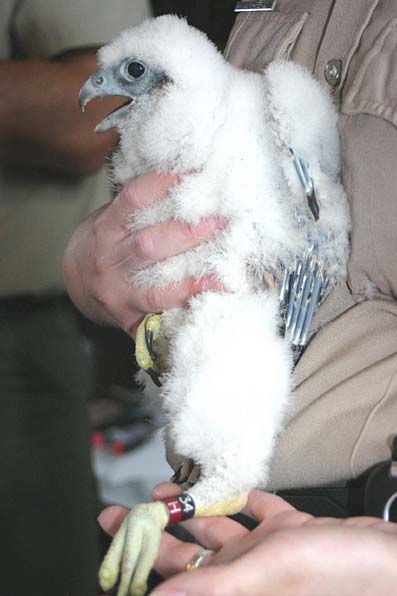
Watch the FalconCam and you will see a drawbridge brought up at the nestbox to prevent the eyasses from falling off the ledge. They will be brought inside the skyscraper and bands with identifying numbers and codes will be attached to their legs so that they can be identified in the future. Recently, a pair of peregrines were spotted in the Cuyahoga Valley National Park, and a falcon fan was able to get a picture showing the bands. The female was Strike, band number 34/H, who is SW’s daughter and hatched in 2009. Here she is at banding day 2009.

Click here to read what happened earlier
Mr. Wright tells us, “Male falcons will sometimes arrive at the nest with live food, but I have only seen this a few times in my years of monitoring. Most times the impact will stun the food and the talons hold the food until the food becomes food. Most times the male will have killed the prey, clipped the wings, taken off the head, and sent the feathers flying in the wind as he cleans the meal before he feeds his mate and chicks. Many times you cannot even tell what the food was before it was the meal. I have seen the following (not in any order, but by how my mind recalls them) brought into the nestbox: Barn Swallow, Tree Swallow, Red Eyed Vireo, Night Hawk, Black and Yellow-billed Cuckoo, Yellow Warbler, Woodcock, Coot, unknown large Sandpiper, Cedar Waxwing, House Sparrow, Rock Dove, Mourning Dove, unknown Seagull, Red- winged Blackbird, Grackle, Pie-billed Grebe, Robin, unknown Thrush, Song Sparrow, Blue Jay, Flicker, Grey Catbird, Goldfinch..... Many times all you can say is that they brought a LBB to the nest (little Brown Bird) or LGB (little grey bird). What do peregrines eat? Anything that flies that is smaller than them."
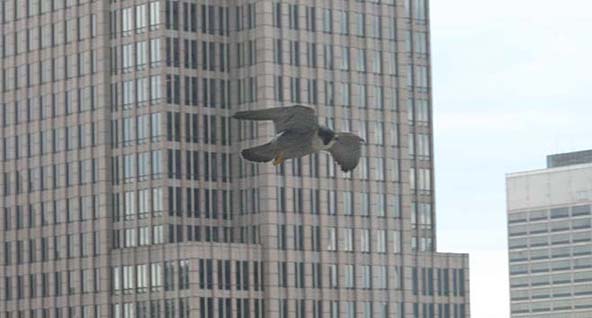
Here is Boomer out hunting.
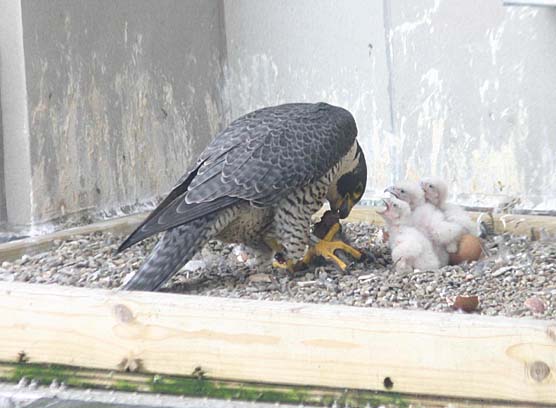
At this point in their lives, the eyasses mostly sleep and eat, and there are several feedings during the day. In a typical feeding sequence, Boomer leaves food on the ledge …..
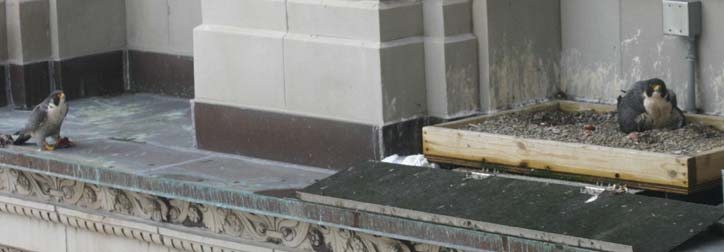
SW comes out of the nestbox to get the food and then takes it into the nest and feeds the eyasses.
Watch the images on the FalconCam as they update through the morning on Wednesday to catch all the action at: http://www.falconcam-cmnh.org/news.php
Our thanks to the Cleveland Museum of Natural History for sponsoring the FalconCams.
Photos are courtesy of Scott Wright, volunteer peregrine nest monitor. They may be used in any non-commercial publication, electronic or print, but please give photo credit.
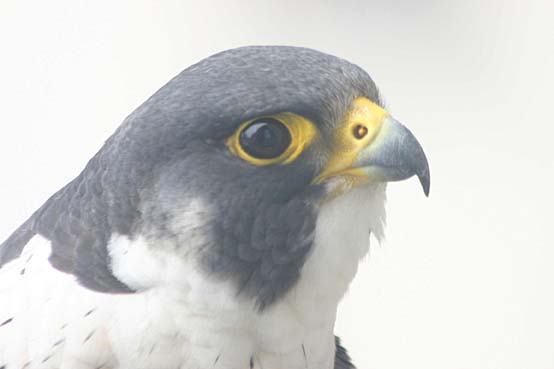
And here is a closeup of Boomer.
Click here to read what happened next
